Reaction equation

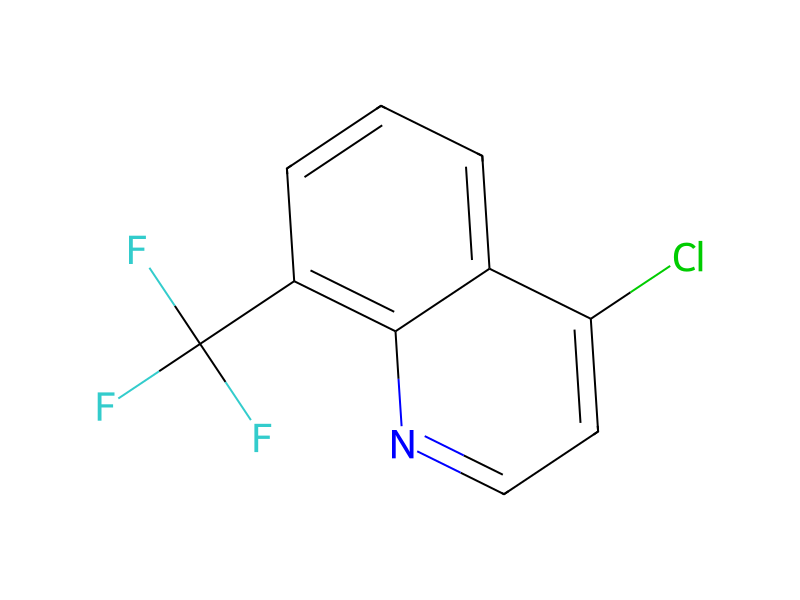
[CH3:1][C:2]1[NH:3][C:4]2[C:9]([CH:10]=1)=[CH:8][C:7]([CH3:11])=[CH:6][CH:5]=2.[Cl:12][C:13]1[C:22]2[C:17](=[C:18]([C:23]([F:26])([F:25])[F:24])[CH:19]=[CH:20][CH:21]=2)[N:16]=[CH:15][CH:14]=1>CN1C(=O)CCC1.Cl.O1CCOCC1>[ClH:12].[CH3:1][C:2]1[NH:3][C:4]2[C:9]([C:10]=1[C:13]1[C:22]3[C:17](=[C:18]([C:23]([F:26])([F:24])[F:25])[CH:19]=[CH:20][CH:21]=3)[N:16]=[CH:15][CH:14]=1)=[CH:8][C:7]([CH3:11])=[CH:6][CH:5]=2Participants
6
Reactant 2

Product 1

Reagents, catalysts & solvents 3



Conditions
- Temperature
- 140 °C
Procedure
A mixture of 2,5-dimethylindole (765 mg) and 4-chloro-8-trifluoromethylquinoline (1.22 g) in NMP (1.5 ml) and 4M HCl in dioxane (0.2 ml) was heated at 140° C. for 1 h. After cooling the mixture was triturated with ether and filtered to give the sub-title compound (1.33 g) as a dark red solid.
Workup
- temperatureAfter cooling the mixture
- customwas triturated with ether
- filtrationfiltered
Sources & evidence
- ORD record
- ord-3d83c96dcd864fa89b3975550fedd3df
- Source dataset
- uspto-grants-2012_01
- Patent number
- US08093278B2
Linked notes
Loading…