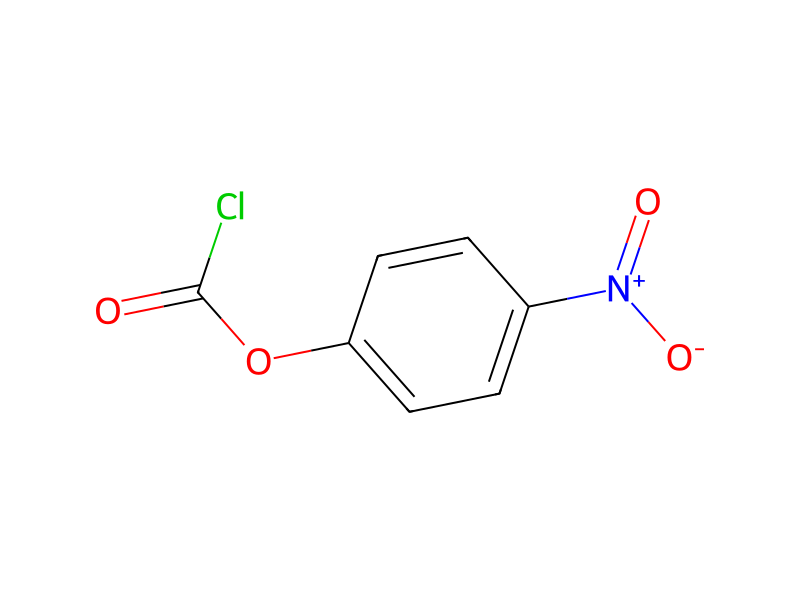
Cl[C:2]([O:4][C:5]1[CH:10]=[CH:9][C:8]([N+:11]([O-:13])=[O:12])=[CH:7][CH:6]=1)=[O:3].Cl.[CH3:15][O:16][C:17](=[O:23])[C@H:18]([CH:20]([CH3:22])[CH3:21])[NH2:19].CN1CCOCC1>C(Cl)Cl>[CH3:15][O:16][C:17](=[O:23])[C@H:18]([CH:20]([CH3:22])[CH3:21])[NH:19][C:2]([O:4][C:5]1[CH:10]=[CH:9][C:8]([N+:11]([O-:13])=[O:12])=[CH:7][CH:6]=1)=[O:3]A solution of 66.1 g (0.328 mol) of 4-nitrophenyl chloroformate in 1.2 liters of CH2Cl2 was cooled to 0° C. and treated with L-valine methyl ester hydrochloride. The resulting mixture was treated slowly, with stirring, with 68.9 ml (0.626 mol) of 4-methylmorpholine. The resulting solution was allowed to slowly warm to ambient temperature and was stirred overnight. After washing with 3 portions of 10% aqueous NaHCO3, the solution was dried over Na2SO4 and concentrated in vacuo. The residue was purified by silica gel chromatography by eluting with chloroform to provide the desired compound. 1H NMR (DMSO-d6) δ 0.94 (d, J=7 Hz, 3H), 0.95 (d, J=7 Hz, 3H), 2.12 (octet, J=7 Hz, 1H), 3.69 (s, 3H), 4.01 (dd, J=8, 6 Hz, 1H), 7.41 (dt, J=9, 3 Hz, 2H), 8.27 (dt, J=9, 3 Hz, 2H), 8.53 (d, J=8 Hz, 1H). Mass spectrum: (M+NH4)+=314.