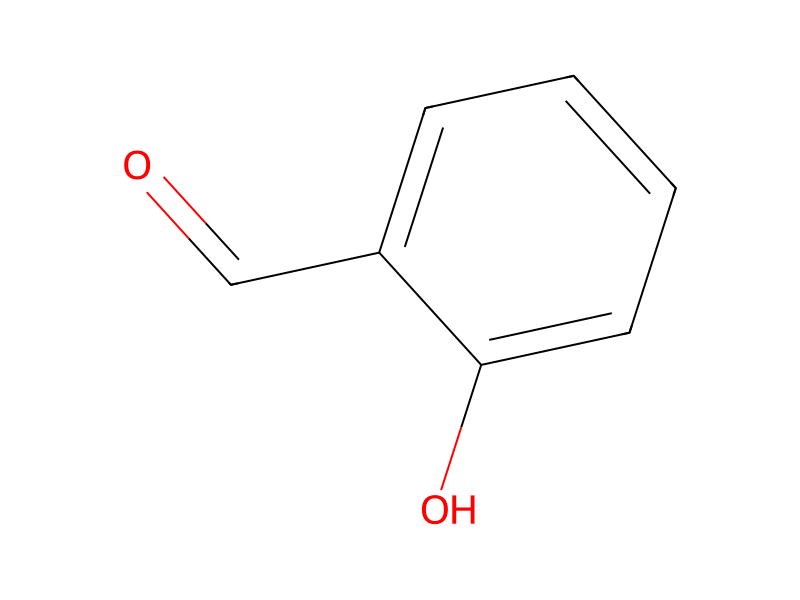
[NH2:1][C:2]1[C:7]([CH3:8])=[CH:6][C:5]([OH:9])=[CH:4][C:3]=1[CH3:10].[CH:11](=O)[C:12]1[C:13](=[CH:15][CH:16]=[CH:17][CH:18]=1)[OH:14].C(OCC)(=O)C>CCCCCC>[OH:14][C:13]1[CH:15]=[CH:16][CH:17]=[CH:18][C:12]=1[CH:11]=[N:1][C:2]1[C:7]([CH3:8])=[CH:6][C:5]([OH:9])=[CH:4][C:3]=1[CH3:10]To a 500 milliliter round bottom flask equipped with a water condenser, magnetic stirrer and drying tube was added 13.72 grams (0.10 mole) of 4-amino-3,5-dimethylphenol, 12.21 grams (0.10 mole) of salicylaldehyde and 250 milliliters of ethyl acetate. The resulting reaction mixture was then heated to 55° C. and stirred for 19 hours at ambient pressure. After cooling the reaction mixture to room temperature, it was filtered and concentrated under reduced pressure to give a brown oil which solidified on standing. The resulting solidified material was slurried in hexane, collected by filtration and dried to yield 19.66 grams (0.082 moles) of 4-(2-hydroxybenzylideneamino)-3,5-dimethylphenol in the form of a yellow solid having a melting point of 145°-147° C.