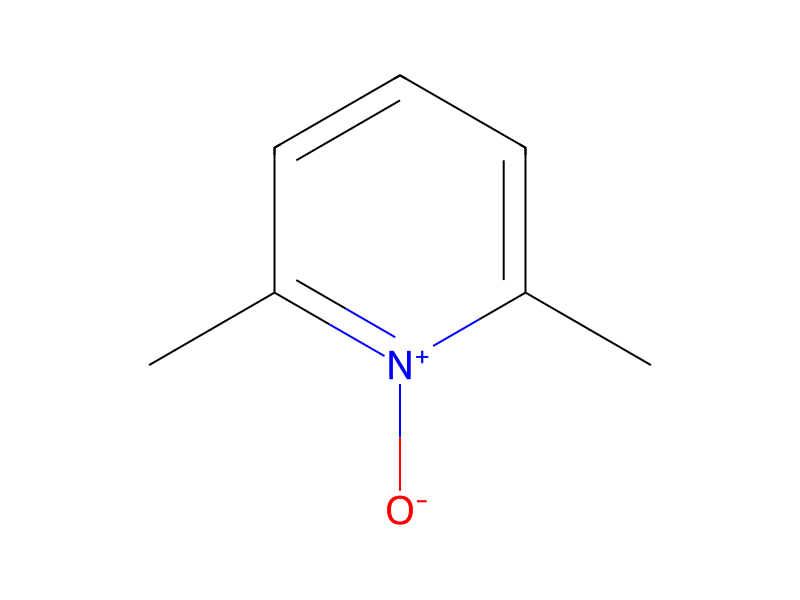
2,6-Lutidine → 2,6-Dimethylpyridine N-oxide
HRID 446813
Reaction equation

[CH3:1][C:2]1[CH:7]=[CH:6][CH:5]=[C:4]([CH3:8])[N:3]=1.C1C=C(Cl)C=C(C(OO)=[O:17])C=1>C(Cl)(Cl)Cl>[CH3:1][C:2]1[CH:7]=[CH:6][CH:5]=[C:4]([CH3:8])[N+:3]=1[O-:17]Participants
4
Reactant 2


Product 1
Reagents, catalysts & solvents 1

Procedure
To a 0° C. solution of 2,6-dimethylpyridine (1.0 g, 0.009 mol) in CHCl3 (25 mL) was added mCPBA (3.17 g, 0.01 mol). The reaction mixture was then stirred for 12 h at RT, quenched with a saturated Na2CO3 solution. The organic layer was separated, dried over Na2SO4 and concentrated in vacuo to afford 2,6-dimethylpyridine 1-oxide (980 mg, 85%) as a solid.
Workup
- customquenched with a saturated Na2CO3 solution
- customThe organic layer was separated
- dry with materialdried over Na2SO4
- concentrationconcentrated in vacuo
Sources & evidence
- ORD record
- ord-5694c3e4dc404594a53163c478a732f0
- Source dataset
- uspto-grants-2013_07
- Patent number
- US08481534B2