Reaction equation
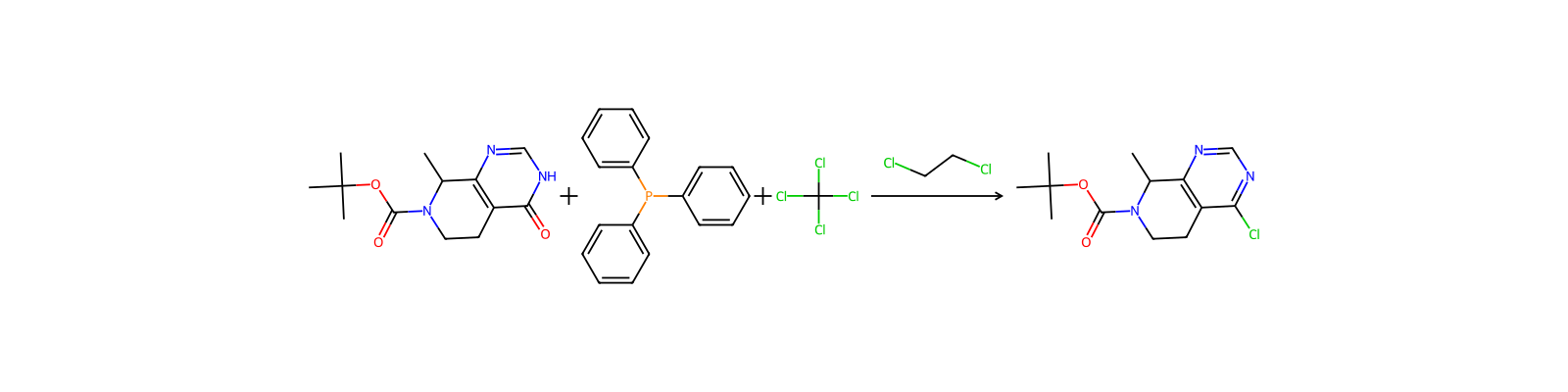
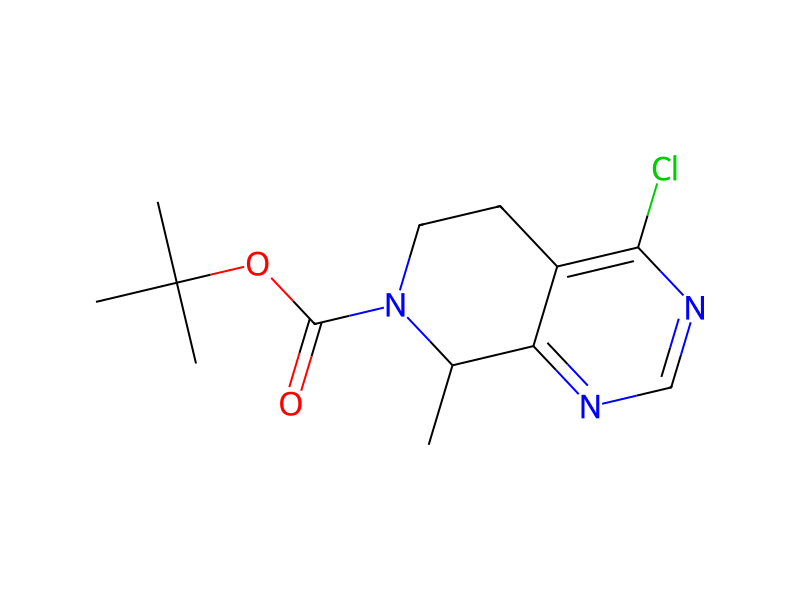
[C:1]([O:5][C:6]([N:8]1[CH2:17][CH2:16][C:15]2[C:14](=O)[NH:13][CH:12]=[N:11][C:10]=2[CH:9]1[CH3:19])=[O:7])([CH3:4])([CH3:3])[CH3:2].C1(P(C2C=CC=CC=2)C2C=CC=CC=2)C=CC=CC=1.C(Cl)(Cl)(Cl)[Cl:40]>ClCCCl>[C:1]([O:5][C:6]([N:8]1[CH2:17][CH2:16][C:15]2[C:14]([Cl:40])=[N:13][CH:12]=[N:11][C:10]=2[CH:9]1[CH3:19])=[O:7])([CH3:4])([CH3:3])[CH3:2]Participants
5
Reactant 3



Product 1
Reagents, catalysts & solvents 1

Procedure
A combination of 8-methyl-4-oxo-4,5,6,8-tetrahydro-3H-pyrido[3,4-d]pyrimidine-7-carboxylic acid tert-butyl ester (374 mg, 1.41 mmol), triphenylphosphine (739 mg, 2.82 mmol) and carbon tetrachloride (409 uL, 4.23 mmol) and 1,2-DCE (10 mL) are heated at 70° C. for 6 h. The solution is then concentrated in vacuo and the residue separated via FCC (5-60% EtOAc/heptane). MS (ESI) m/z 284.2 (M+H).
Workup
- concentrationThe solution is then concentrated in vacuo
- customthe residue separated via FCC (5-60% EtOAc/heptane)
Sources & evidence
- ORD record
- ord-9c4857f56dee46a2b95e526441dc6d5f
- Source dataset
- uspto-grants-2013_07
- Patent number
- US08486954B2
Linked notes
Loading…