Reaction equation

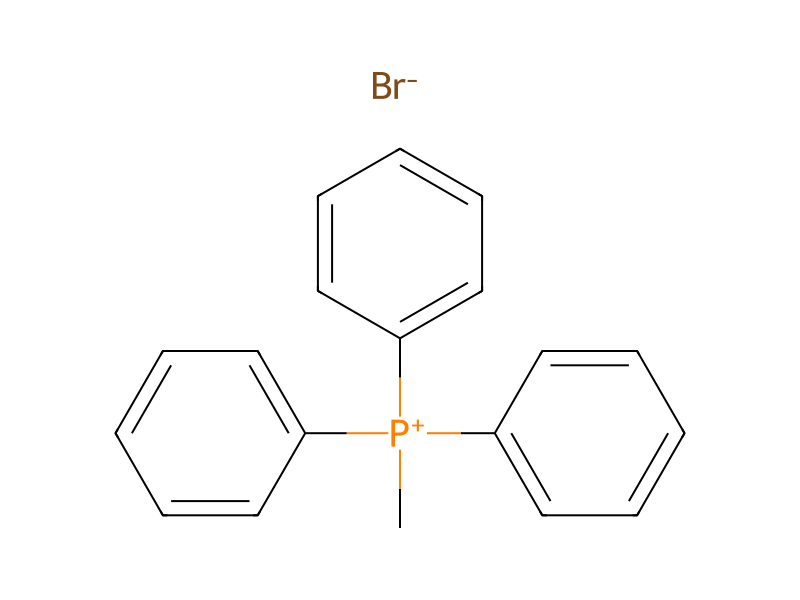
[CH2:1]([Li])CCC.[Cl:6][C:7]1[CH:8]=[C:9]([CH:12]=[CH:13][C:14]=1[O:15][Si](C(C)(C)C)(C)C)[CH:10]=O>[Br-].C[P+](C1C=CC=CC=1)(C1C=CC=CC=1)C1C=CC=CC=1.C1COCC1>[Cl:6][C:7]1[CH:8]=[C:9]([CH:10]=[CH2:1])[CH:12]=[CH:13][C:14]=1[OH:15]Participants




Conditions
- Temperature
- 0 °C
Procedure
To a slurry of methyltriphenylphosphonium bromide (0.23 g) in dry THF (5 ml) under nitrogen at −78° C., n-butyl lithium (1.6M in hexanes, 0.37 ml) was added dropwise over 2 min. The mixture was allowed to warm to 0° C., stirred for 20 min, cooled to −78° C. and a solution of 3-chloro-4-[[(1,1-dimethylethyl)dimethylsilyl]oxy]benzaldehyde* (0.134 g) in dry THF (5 ml) added. The reaction mixture was allowed to reach room temperature overnight and quenched with saturated aqueous ammonium chloride. The resultant mixture was extracted with diethyl ether and the combined organic extracts were concentrated under reduced pressure. The residue was purified using SPE (silica, eluting with cyclohexane, followed by 5% to 25% ethyl acetate:cyclohexane) to give the title compound (0.049 g) as an oil. *Boukouvalas, J; Maltais, F; Lachance, N., Tetrahedron Lett. (1994), 35(43), 7897–900.
Workup
- temperaturecooled to −78° C.
- waitto reach room temperature overnight
- customquenched with saturated aqueous ammonium chloride
- extractionThe resultant mixture was extracted with diethyl ether
- concentrationthe combined organic extracts were concentrated under reduced pressure
- customThe residue was purified
- washSPE (silica, eluting with cyclohexane, followed by 5% to 25% ethyl acetate:cyclohexane)
Sources & evidence
- ORD record
- ord-5de794f859594626b87b800a3369c5bb
- Source dataset
- uspto-grants-2007_03
- Patent number
- US07186717B2
Linked notes
Loading…