Reaction equation

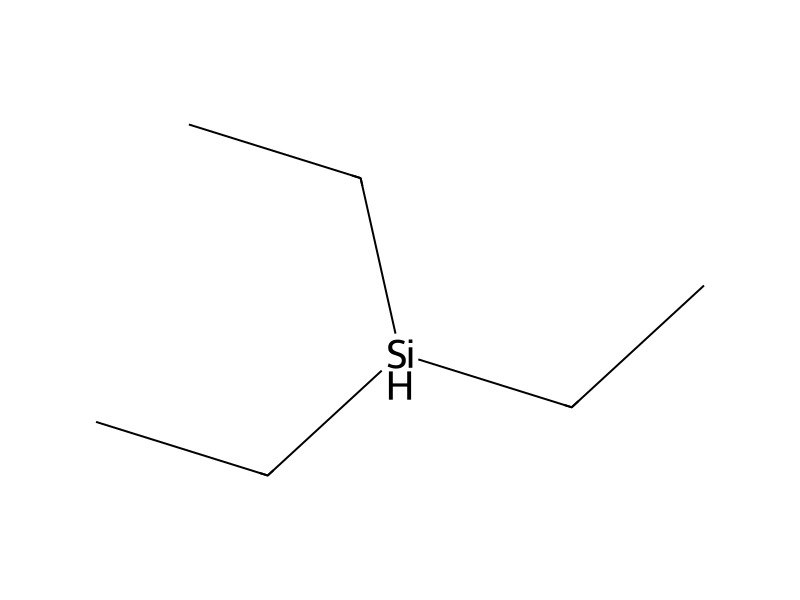
[Br:1][C:2]1[C:7]2[O:8][CH2:9][O:10][C:6]=2[CH:5]=[C:4]([CH:11](O)[CH:12]([CH3:14])[CH3:13])[CH:3]=1.C([SiH](CC)CC)C.FC(F)(F)C(O)=O.O>ClCCl>[Br:1][C:2]1[C:7]2[O:8][CH2:9][O:10][C:6]=2[CH:5]=[C:4]([CH2:11][CH:12]([CH3:14])[CH3:13])[CH:3]=1Participants
6





Conditions
- Temperature
- 0 °C
Procedure
To a cold solution (0° C.) of 1-(7-bromo-benzo[1,3]dioxol-5-yl)-2-methyl-propan-1-ol (498 mg, 1.82 mmol) in dry dichloromethane (10 mL) was added triethylsilane (0.6 mL, 3.65 mmol). After 15 minutes, trifluoroacetic acid was added to the reaction and the mixture stirred at 0° C. for 45 minutes. Water was poured into the reaction mixture and the layers separated. The organic layer was further washed with water, aqueous NaHCO3 and brine, dried (MgSO4), filtered and evaporated. The residue was purified on silica gel (5% ethyl acetate in hexane) to give 242 mg of 4-bromo-6-isobutyl-benzo[1,3]dioxole (52%). 1H NMR (300 MHz; CDCl3): δ 0.90 (d, J=6.3 Hz, 6H), 1.81 (m, 1H), 2.39 (d, J=7.5 Hz, 2H), 6.01 (s, 2H), 6.58 (s, 1H), 6.76 (s, 1H).
Workup
- customthe layers separated
- washThe organic layer was further washed with water, aqueous NaHCO3 and brine
- dry with materialdried (MgSO4)
- filtrationfiltered
- customevaporated
- customThe residue was purified on silica gel (5% ethyl acetate in hexane)
Sources & evidence
- ORD record
- ord-6fcf7cb8bdb94600a5a6b80f990952fd
- Source dataset
- uspto-grants-2007_03
- Patent number
- US07196108B2
Linked notes
Loading…