Reaction equation
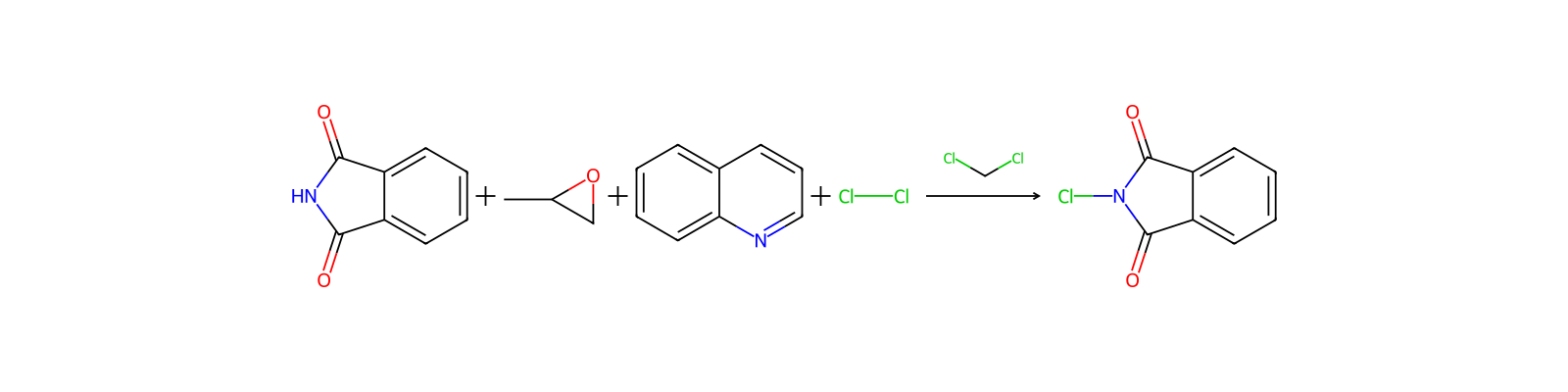
[C:1]1(=[O:11])[NH:5][C:4](=[O:6])[C:3]2=[CH:7][CH:8]=[CH:9][CH:10]=[C:2]12.C1OC1C.N1C2C(=CC=CC=2)C=CC=1.[Cl:26]Cl>C(Cl)Cl>[Cl:26][N:5]1[C:1](=[O:11])[C:2]2=[CH:10][CH:9]=[CH:8][CH:7]=[C:3]2[C:4]1=[O:6]Participants
Reactant 4



Product 1

Reagents, catalysts & solvents 1

Conditions
- Temperature
- 0 °C
Procedure
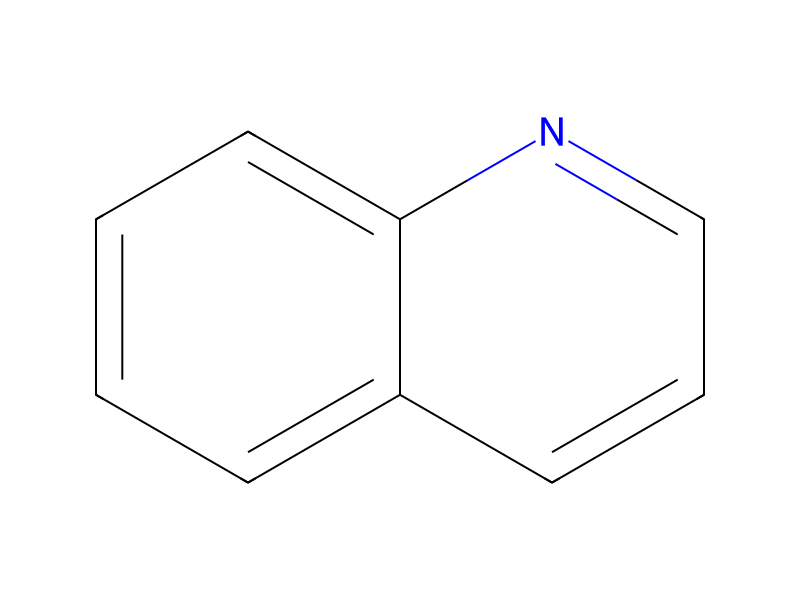
To 150 ml. of methylene chloride were added 7.35 g. (0.05 mole) of phthalimide and 17.5 ml. (5 equiv.) of propylene oxide. The resulting mixture was cooled to 0° C., 0.13 g. (0.001 mole; 0.02 equiv.) of quinoline was added, and the mixture was saturated with chlorine. The phthalimide began to dissolve within 30 minutes, and after one hour it was nearly all dissolved. Analysis of the sample by TLC at 1.25 hours showed only a trace of starting material. The mixture was subjected to partial vacuum to remove excess chlorine, and a small amount of amylene was added. The resulting mixture then was evaporated to obtain crystalline N-chlorophthalimide. The product was filtered and vacuum dried overnight to give 8.2 g. (90.4%) of product. Analysis: (1) Percent Cl+ : Theory: 19.6; Found: 19.3. (2) Percent total chlorine: 19.1.
Workup
- dissolutionto dissolve within 30 minutes
- waitAnalysis of the sample by TLC at 1.25 hours showed only
- customto remove excess chlorine
- additiona small amount of amylene was added
- customThe resulting mixture then was evaporated
Sources & evidence
- ORD record
- ord-2f26cd228afd474bb813427d4b38d35d
- Source dataset
- uspto-grants-1979_11
- Patent number
- US04175082
Linked notes
Loading…