Pyrazole → Penicillanic Acid
HRID 485684
Reaction equation

[CH3:1][C:2]1([CH3:25])[S:6][C@@H:5]2[C@H:7](NC([C@H](N)C3C=CC(O)=CC=3)=O)[C:8](=[O:9])[N:4]2[C@H:3]1[C:22]([OH:24])=[O:23].CC1(C)S[C@@H]2[C@H](NC(CC3C=CC=CC=3)=O)C(=O)N2[C@H]1C([O-])=O.[K+].N1C=CC=N1.[Na]>>[CH3:1][C:2]1([CH3:25])[S:6][C@@H:5]2[CH2:7][C:8](=[O:9])[N:4]2[C@H:3]1[C:22]([OH:24])=[O:23]Participants
5
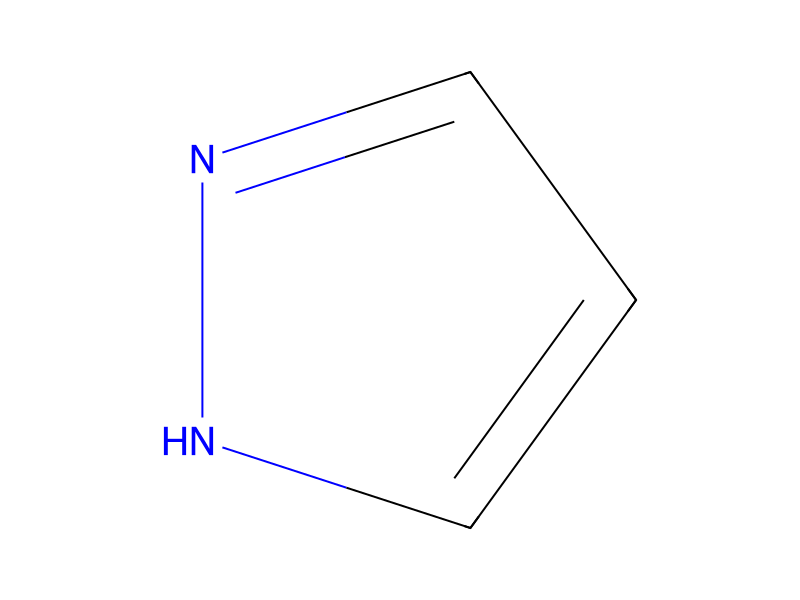




Procedure
The free penicillanic acid of the title compound was prepared in the same manner as in Example 11(c), except that amoxycillin trihydrate was used in place of ampicillin. The free acid possessed δ(CD3OD) 1.50, 1.57(2×3H, 2s, gem dimethyls), 4.37 (1H, s, C3 penicillin proton), 5.58 (2H, m, C5 and C6 penicillin protons), 5.78 (1H, s, --CH--CONH--), 6.85(2H, d, J9 Hz, 2 aryl protons), 7.43 (2H, d, J9Hz 2 aryl protons), 7.85 (2H, d, J8Hz, 2 aryl protons), 8.30 (2H, d, J8Hz, 2 aryl protons), 8.61 (1H, s, C3 pyrazole proton). The free acid was converted to the sodium salt in a manner analogous to example 6(b). The sodium salt possessed νmax (Nujol) 1760, 1560 cm-1. MIC against E.coli NCTC 10418 5 μg/ml.