Reaction equation

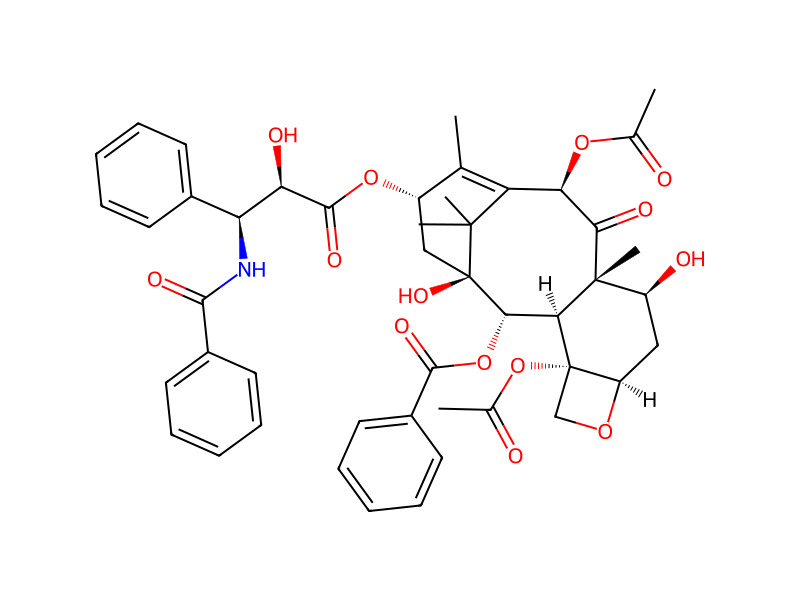
CC1[C@@H]([O:20][C:21]([C@H:23]([OH:40])[C@@H:24]([NH:31]C(C2C=CC=CC=2)=O)[C:25]2[CH:26]=[CH:27][CH:28]=[CH:29][CH:30]=2)=[O:22])C[C@]2(O)C(C)(C)C=1[C@@H](OC(C)=O)C([C@@]1(C)[C@H]([C@@H]2OC(C2C=CC=CC=2)=O)[C@]2(OC(C)=O)CO[C@@H]2C[C@@H]1O)=O.C(N[C@@H](C1C=CC=CC=1)[C@H](C(O)=O)O)(=O)C1C=CC=CC=1.[ClH:84]>>[C:25]1([C@@H:24]([C@H:23]([C:21]([OH:22])=[O:20])[OH:40])[NH2:31])[CH:30]=[CH:29][CH:28]=[CH:27][CH:26]=1.[ClH:84]Participants
5



Procedure
When the desired product is the side chain of taxol, N-benzoyl-(2R,3S)-3-phenylisoserine, R1 is phenyl, and R7 is preferably trimethylsilyl. In this synthesis the product of the reaction Scheme 1 is (3R,4S)-3-triisopropylsilyloxy-4-phenyl-2-azetidin-2-one (see Scheme 2), which is hydrolyzed, for example with hydrochloric acid, to yield the corresponding (2R,3S)-3-phenylisoserine as hydrochloric acid salt. The phenylisoserine is then benzoylated by procedures known in the art, for example, the Schotten-Baumann procedure, and purified, if necessary, by recrystallization or through a short silica gel column to give enantiomerically pure N-benzoyl-(2R,3S)-3-phenylisoserine (see Scheme 3).
Workup
- customIn this synthesis
- customthe product of the reaction Scheme 1
Sources & evidence
- ORD record
- ord-05c00a002a324716adc70b5184b49e02
- Source dataset
- uspto-grants-1994_03
- Patent number
- US05294737
Linked notes
Loading…