2-Bromopyridine → 3-Methyl-1-pyridin-2-ylpiperazine hydrobromide
HRID 490179
Reaction equation

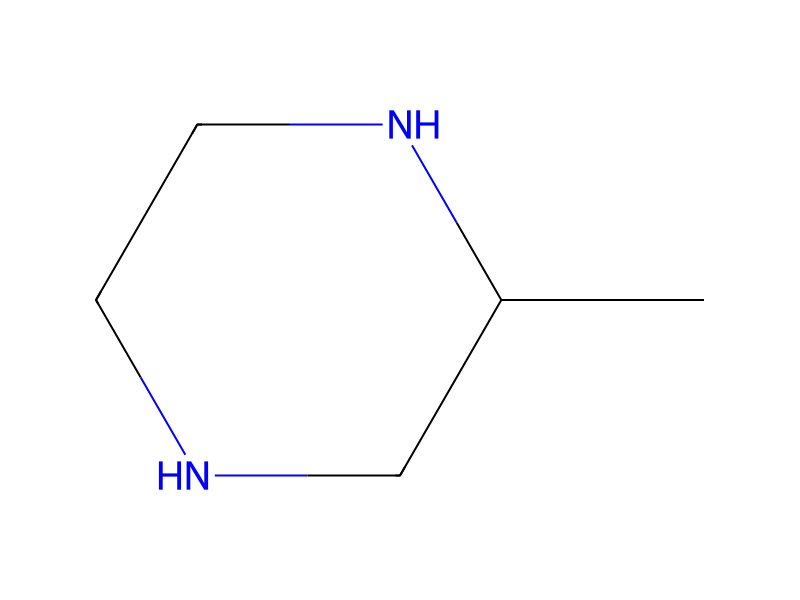
[CH3:1][CH:2]1[CH2:7][NH:6][CH2:5][CH2:4][NH:3]1.[Br:8][C:9]1[CH:14]=[CH:13][CH:12]=[CH:11][N:10]=1>>[BrH:8].[CH3:1][CH:2]1[NH:3][CH2:4][CH2:5][N:6]([C:9]2[CH:14]=[CH:13][CH:12]=[CH:11][N:10]=2)[CH2:7]1Participants
3


Procedure
A solution of 2-methylpiperazine (1.0 g, 0.01 mol, racemic mixture) and 2-bromopyridine (10 mL, 0.1 mol) was heated to 120° C. for 16 hours. The reaction mixture was cooled to room temperature and partitioned between ethyl acetate and water. The layers were separated, and the water layer was concentrated under reduced pressure. The residue was triturated with ethyl acetate, dichloromethane, and methanol to afford 460 mg (26% yield) of racemic 3-methyl-1-pyridin-2-yl-piperazine hydrobromide as an off-white solid. 1H NMR (300 MHz, DMSO-d6) δ 1.27 (d, J=6.6 Hz, 3H), 2.90 (dd, J=10.5, 14.1 Hz, 1H), 3.10 (m, 2H), 3.40 (m, 2H), 4.32 (m, 2H), 6.77 (dd, J=4.8, 6.9 Hz, 1H), 6.98 (d, J=8.1 Hz, 1H), 7.64 (m, 1H), 8.15 (m, 1H), 8.63 (br s, 1H), 8.92 (br s, 1H); MS (APCI) m/e 178 (M+H) +.