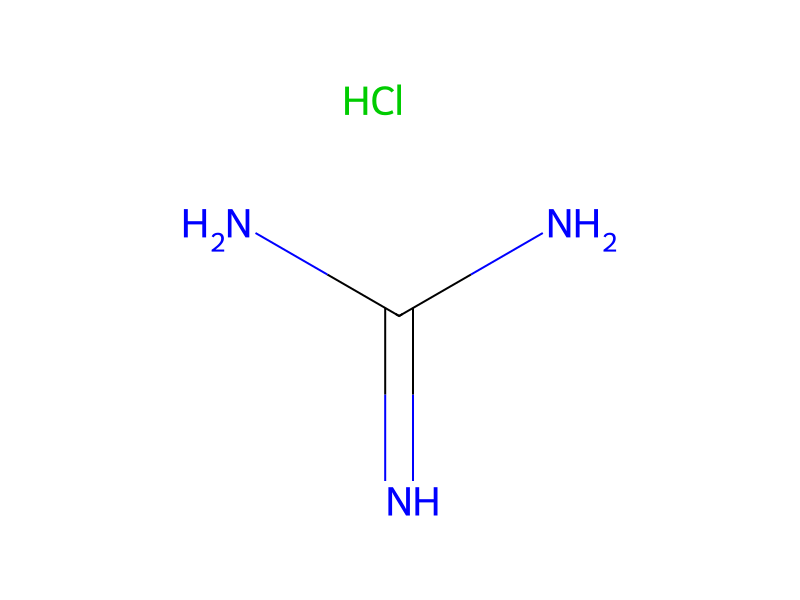
3.11 g (32.55 mmol) of guanidine hydrochloride are added to a solution of 1.76 g (32.55 mmol) of sodium methoxide in 60 cm3 of methanol at a temperature in the region of 20° C. under an argon atmosphere. After stirring at this temperature for 2 hours, the mixture is concentrated to dryness under reduced pressure (2.7 kPa). The residue is taken up in 60 cm3 of 1,2-dimethoxyethane, and 2.46 g (6.51 mmol) of 5-chloro-3-chlorocarbonyl-1-(quinolin-4-yl)-1H-indole hydrochloride are added. After stirring at the reflux temperature of the solvent for 2 hours, the reaction mixture is concentrated to dryness under reduced pressure (2.7 kPa). The residue is triturated in 250 cm3 of water and the suspension is filtered and then dried. The residue is purified by chromatography on silica gel [eluent: dichloromethane/methanol (85/15 by volume)]. After the fractions containing the expected product have been concentrated to dryness under reduced pressure (2.7 kPa), 1.2 g of 5-chloro-3-guanidinocarbonyl-1-(quinolin-4-yl)-1H-indole are obtained in the form of a beige-colored powder melting at a temperature above 260° C. Mass spectrum (CI): m/e 363 (M+H)+)+ (base peak). IR spectrum (KBr): 3466; 3398; 3322; 1636; 1593; 1571; 1510; 1451; 1383; 1356; 1265; 1219; 881; 810; 792; 775 and 649 cm−1.