Reaction equation

F[C:2]1[CH:3]=[C:4]([N+:8]([O-:10])=[O:9])[CH:5]=[CH:6][CH:7]=1.[NH:11]1[CH2:16][CH2:15][NH:14][CH2:13][CH2:12]1.O>CN1C(=O)CCC1>[N+:8]([C:4]1[CH:3]=[C:2]([N:11]2[CH2:16][CH2:15][NH:14][CH2:13][CH2:12]2)[CH:7]=[CH:6][CH:5]=1)([O-:10])=[O:9]Participants
Reactant 3



Product 1
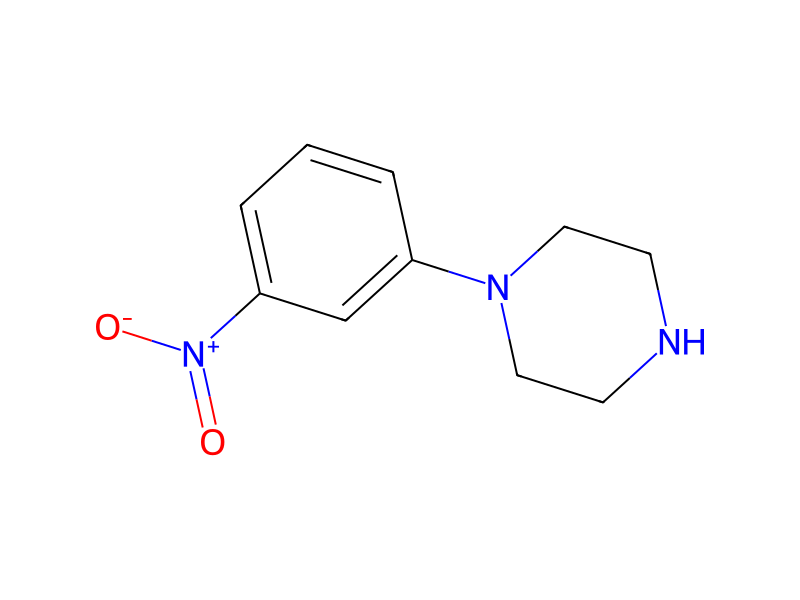
Reagents, catalysts & solvents 1

Conditions
- Temperature
- 115 °C
Procedure
A mixture of 3-fluoronitrobenzene (10.7 ml, 0.1 mol) and piperazine (43 g, 0.5 mol) in anhydrous NMP was heated to 115° C. for 2 days. After cooling the mixture was poured into water (200 ml) and extracted with ethyl acetate (3×50 ml). The combined organic extracts were washed with brine, dried over sodium sulfate and concentrated under reduced pressure. The residue was purified by column-chromatography on silica gel with a mixture of dichloromethane, methanol and aqueous ammonia (90:10:1 v/v/v) as the eluent to yield 1-(3-nitrophenyl)piperazine (17.2 g, 83%). This intermediate was acetylated with acetic acid anhydride (yield: 90%) and hydrogenated in methanol at ambient pressure using Pd (5% on activated carbon) as the catalyst to yield 2d (11.9 g, 74%) as off-white crystals.
Workup
- temperatureAfter cooling the mixture
- extractionextracted with ethyl acetate (3×50 ml)
- washThe combined organic extracts were washed with brine
- dry with materialdried over sodium sulfate
- concentrationconcentrated under reduced pressure
- customThe residue was purified by column-chromatography on silica gel with a mixture of dichloromethane, methanol and aqueous ammonia (90:10:1 v/v/v) as the eluent
Sources & evidence
- ORD record
- ord-f84c3da4ed9046d7aef2c2e419510a17
- Source dataset
- uspto-grants-2004_03
- Patent number
- US06710044B2
Linked notes
Loading…