Reaction equation
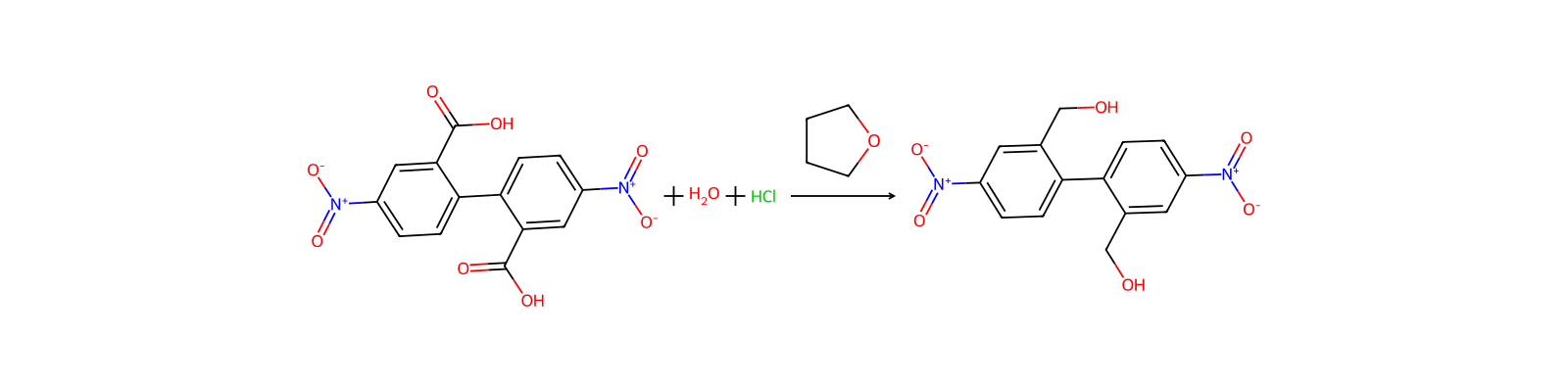
[N+:1]([C:4]1[CH:5]=[C:6]([C:22](O)=[O:23])[C:7]([C:10]2[C:11]([C:19](O)=[O:20])=[CH:12][C:13]([N+:16]([O-:18])=[O:17])=[CH:14][CH:15]=2)=[CH:8][CH:9]=1)([O-:3])=[O:2].O.Cl>O1CCCC1>[N+:1]([C:4]1[CH:5]=[C:6]([CH2:22][OH:23])[C:7]([C:10]2[C:11]([CH2:19][OH:20])=[CH:12][C:13]([N+:16]([O-:18])=[O:17])=[CH:14][CH:15]=2)=[CH:8][CH:9]=1)([O-:3])=[O:2]Participants
5
Reactant 3



Product 1

Reagents, catalysts & solvents 1

Procedure
3.6 g (10.83 mmol) 4,4′-Dinitro-1,1′-biphenyl-2,2′-dicarboxylic acid is dissolved in 25 ml tetrahydrofuran and added drop wise in a the course of 1 hours to 65 ml (65.02 mmol) of a borane-tetrahydrofuran complex 1.0 M solution in tetrahydrofuran. After 19 hours at 25° C., 50 ml water is carefully added. After 1 h the solution is acidified to pH=1-2 with 10 ml 1N HCl solution and allowed to stirred for 30 min. The reaction mixture is then partitioned between ethyl acetate and water; the organic phase is washed repeatedly with water, dried over sodium sulfate, filtered and concentrated by rotary evaporation. The residue, 4.2 g of 4,4′-Dinitro-1,1′-biphenyl-2,2′-dimethanol as white powder is used without further purification.
Workup
- customThe reaction mixture is then partitioned between ethyl acetate and water
- washthe organic phase is washed repeatedly with water
- dry with materialdried over sodium sulfate
- filtrationfiltered
- concentrationconcentrated by rotary evaporation
- customThe residue, 4.2 g of 4,4′-Dinitro-1,1′-biphenyl-2,2′-dimethanol as white powder is used without further purification
Sources & evidence
- ORD record
- ord-b3575316b53947208f22b732357d6751
- Source dataset
- uspto-grants-2015_08
- Patent number
- US09097938B2
Linked notes
Loading…