Reaction equation
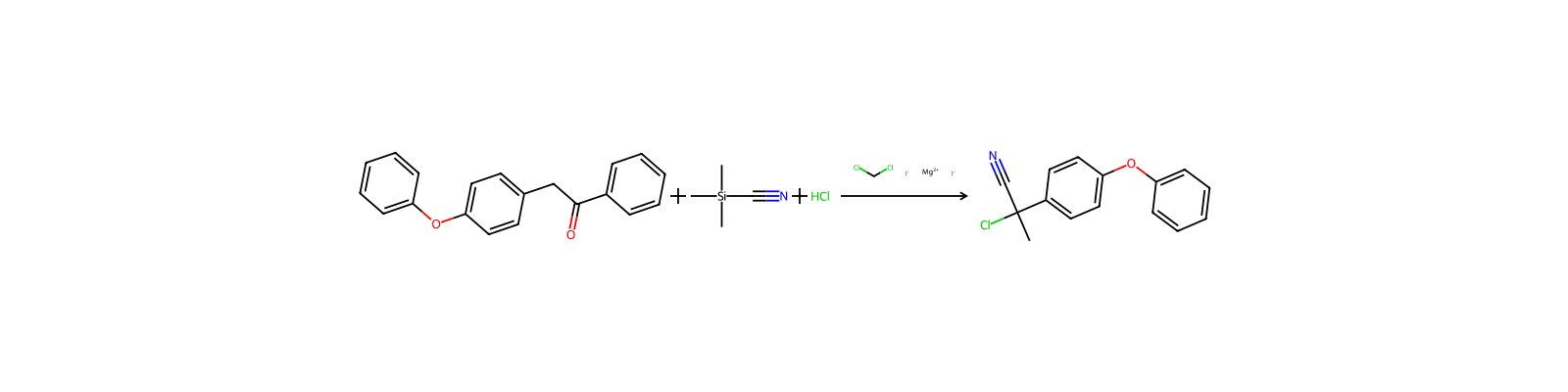
[O:1]([C:8]1[CH:13]=[CH:12][C:11]([CH2:14][C:15](C2C=CC=CC=2)=O)=[CH:10][CH:9]=1)[C:2]1[CH:7]=[CH:6][CH:5]=[CH:4][CH:3]=1.C[Si]([C:27]#[N:28])(C)C.[ClH:29]>C(Cl)Cl.[I-].[Mg+2].[I-]>[Cl:29][C:14]([C:11]1[CH:10]=[CH:9][C:8]([O:1][C:2]2[CH:3]=[CH:4][CH:5]=[CH:6][CH:7]=2)=[CH:13][CH:12]=1)([CH3:15])[C:27]#[N:28]Participants




Procedure
A mixture of 4-phenoxyphenylacetophenone (6.36 g), trimethylsilylcyanide (3.96 g) and magnesium iodide (10 mg) in methylene chloride (30 ml) was stirred for 12 hrs at room temperature, 15% hydrochloric acid (10 ml) was then added. The mixture was again stirred for 8 hrs at room temperature. The organic layer was separated and dried over anhydrous magnesium sulfate. The solvent was removed under reduced pressure. The residue was dissolved in benzene (50 ml) and pyridine (2.37 g) and thionyl chloride (4.76 g) were added at 0° C. with stirring. The reaction mixture was stirred for an additional 3 hrs at room temperature and then the solvent was evaporated. The residue was purified by column chromatography to give 7.09 g of 2-chloro-2-(4-phenoxyphenyl)propionitrile as an oil.
Workup
- stirringThe mixture was again stirred for 8 hrs at room temperature
- customThe organic layer was separated
- dry with materialdried over anhydrous magnesium sulfate
- customThe solvent was removed under reduced pressure
- dissolutionThe residue was dissolved in benzene (50 ml)
- additionpyridine (2.37 g) and thionyl chloride (4.76 g) were added at 0° C.
- stirringwith stirring
- stirringThe reaction mixture was stirred for an additional 3 hrs at room temperature
- customthe solvent was evaporated
- customThe residue was purified by column chromatography
Sources & evidence
- ORD record
- ord-ff306ddd6e434acab73221100de33b89
- Source dataset
- uspto-grants-2004_03
- Patent number
- US06713629B2
Linked notes
Loading…