HomeMCPWorkbenchSkills
HomeWorkbenchNotificationsMe
llms.txt · MCP GuidePrivacy Policy · Terms of Service · Supportv1.8.3
  1. Home
  2. /Reaction

Ethyl Acetate → N-(3-chloro-1-(pyridin-3-yl)-1H-pyrazol-4-yl)-3-((3,3,3-trifluoropropyl)thio)propanamide

HRID 515006
Print

Reaction equation

HRID 515006 reaction equation
[Cl:1][C:2]1[C:6]([NH2:7])=[CH:5][N:4]([C:8]2[CH:9]=[N:10][CH:11]=[CH:12][CH:13]=2)[N:3]=1.C(OCC)(=O)C.C(=O)(O)[O-].[Na+].[F:25][C:26]([F:36])([F:35])[CH2:27][CH2:28][S:29][CH2:30][CH2:31][C:32](Cl)=[O:33]>O>[Cl:1][C:2]1[C:6]([NH:7][C:32](=[O:33])[CH2:31][CH2:30][S:29][CH2:28][CH2:27][C:26]([F:25])([F:35])[F:36])=[CH:5][N:4]([C:8]2[CH:9]=[N:10][CH:11]=[CH:12][CH:13]=2)[N:3]=1
ParticipantsProcedureWorkupSources & evidenceReaction notes

Participants

6

Reactant 4

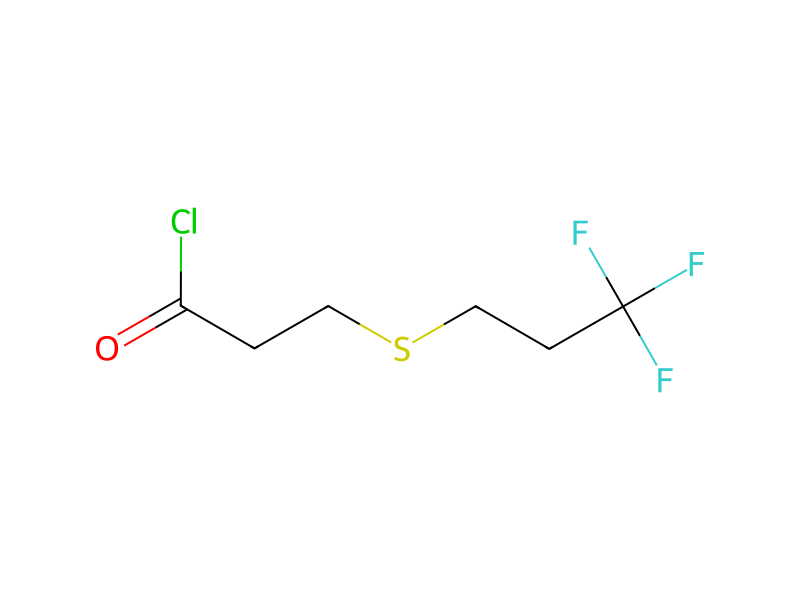
HCID 8857Ethyl Acetate2×HCID 516892Sodium BicarbonateHCID 674993943-chloro-1-(pyridin-3-yl)-1H-pyrazol-4-amineHCID 867006283-((3,3,3-Trifluoropropyl)thio)propanoyl chloride

Product 1

HCID 86700584N-(3-chloro-1-(pyridin-3-yl)-1H-pyrazol-4-yl)-3-((3,3,3-trifluoropropyl)thio)propanamideYield 72%

Reagents, catalysts & solvents 1

HCID 962WaterSolvent

Procedure

A 100-mL, three-neck round bottom flask was charged with 3-chloro-(pyridin-3-yl)-1H-pyrazol-4-amine (1.00 g, 5.14 mmol) and ethyl acetate (10 mL). Sodium bicarbonate (1.08 g, 12.9 mmol) was added, followed by dropwise addition of 3-((3,3,3-trifluoropropyl)thio)-propanoyl chloride (1.36 g, 6.17 mmol) at <20° C. The reaction was stirred at 20° C. for 2 hours, at which point thin layer chromatography analysis [Eluent: ethyl acetate] indicated that the reaction was complete. The reaction was diluted with water (50 mL) and the layers separated. The aqueous layer was extracted with ethyl acetate (20 mL) and the combined organic layers were concentrated to dryness to afford a light brown oil. The residue was purified by flash column chromatography using 30-60% ethyl acetate/hexanes. The fractions containing pure product were concentrated to dryness to afford a white solid (1.40 g, 72%): mp 99-102° C.; 1H NMR (400 MHz, DMSO-d6) δ 9.92 (s, 1H), 9.05 (d, J=2.7 Hz, 1H), 8.86 (s, 1H), 8.54 (dd, J=4.5, 1.4 Hz, 1H), 8.21 (ddd, J=8.4, 2.7, 1.4 Hz, 1H), 7.54 (dd, J=8.4, 4.7 Hz, 1H), 2.86 (t, J=7.3 Hz, 2H), 2.74 (td, J=6.5, 5.6, 4.2 Hz, 4H), 2.59 (ddd, J=11.7, 9.7, 7.4 Hz, 2H); 13C NMR (101 MHz, DMSO-d6) δ 169.32, 147.49, 139.44, 135.47, 133.40, 126.60 (q, J=296 Hz), 125.49, 124.23, 122.30, 120.00, 35.18, 33.42 (q, J=27.2 Hz), 26.77, 23.05 (q, J=3.3 Hz); EIMS m/z 378 ([M]+).


Workup

  1. customthe layers separated
  2. extractionThe aqueous layer was extracted with ethyl acetate (20 mL)
  3. concentrationthe combined organic layers were concentrated to dryness
  4. customto afford a light brown oil
  5. customThe residue was purified by flash column chromatography
  6. additionThe fractions containing pure product
  7. concentrationwere concentrated to dryness

Sources & evidence

ORD record
ord-db395f07afae4aaeb7f5298a3c04208f
Source dataset
uspto-grants-2015_08
DOI
10.6084/m9.figshare.5104873.v1
Patent number
US09108946B2

Reaction notes

On this pageParticipantsProcedureWorkupSources & evidenceReaction notes