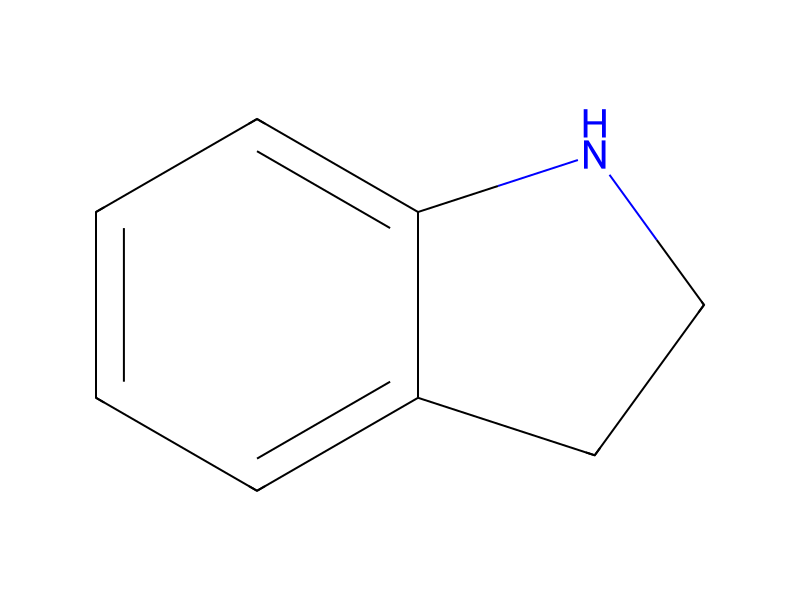
[NH:1]1[C:9]2[C:4](=[CH:5][CH:6]=[CH:7][CH:8]=2)[CH2:3][CH2:2]1.C(N(CC)CC)C.[C:17](Cl)(=[O:23])[C:18]([O:20][CH2:21][CH3:22])=[O:19]>ClCCl.[Cl-].[Na+].O>[C:17]([N:1]1[C:9]2[C:4](=[CH:5][CH:6]=[CH:7][CH:8]=2)[CH2:3][CH2:2]1)([C:18]([O:20][CH2:21][CH3:22])=[O:19])=[O:23]To a solution of indoline (2.0 g, 16.8 mmol) and triethylamine (5 mL) in dichloromethane (30 mL) was added slowly ethyl chlorooxalate (2.3 mL, 20.1 mmol) at 0° C. The mixture was stirred for 10 min at 0° C. and then for 1 h at room temperature. Brine was added and organic layer was separated. The organic layer was washed with diluted aqueous hydrochloric acid and successively brine, dried over magnesium sulfate, and concentrated to give 4.0 g of N-ethoxalylindoline (100%): 1H NMR (270 MHz, CDCl3) δ8.18 (dd, 1H, J=8, 1 Hz), 7.22 (m, 2H), 7.10 (dd, 1H, J=8, 1 Hz), 4.38 (q, 2H, J=7 Hz), 4.22 (t, 2H, J=8 Hz), 3.20 (t, 2H, J=8 Hz), 1.40 (t, 3H, J=7 Hz).