Reaction equation

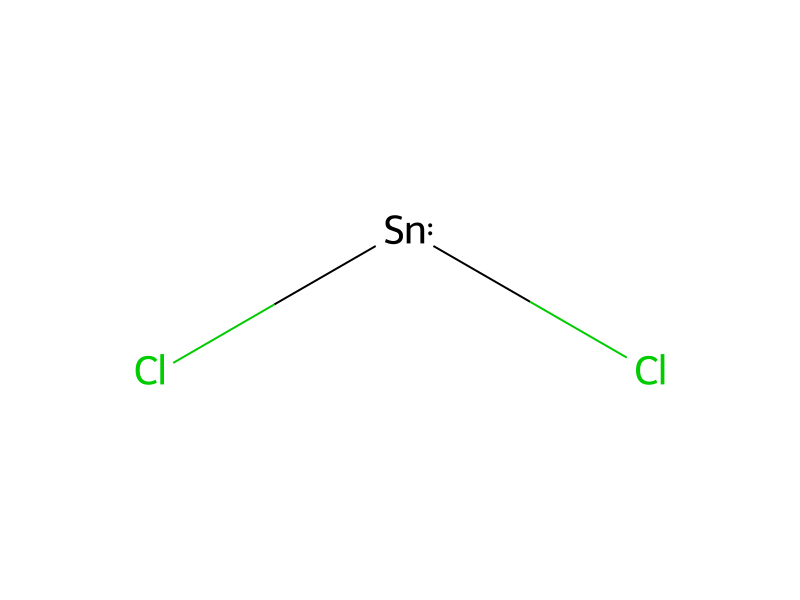
[Cl:1][C:2]1[CH:8]=[C:7]([F:9])[CH:6]=[C:5]([N+:10]([O-])=O)[C:3]=1[NH2:4].Cl[Sn]Cl.C(O)C.C([O-])(O)=O.[Na+]>C(OCC)(=O)C>[NH2:10][C:5]1[CH:6]=[C:7]([F:9])[CH:8]=[C:2]([Cl:1])[C:3]=1[NH2:4]Participants
Reactant 4



Product 1

Reagents, catalysts & solvents 1

Procedure
1,2-Diamino-3-chloro-5-fluorobenzene was prepared using an adaptation of the method of Bellamy, et al., (Bellamy, F. D. et al., Tetrahedron Lett. 25:839 (1984)). A mixture of 2-chloro-4-fluoro-6-nitroaniline (424 mg, 2.22 mmol) and SnCl2 2H2O (2.50 g, 11.1 mmol) dissolved in 7 mL ethyl acetate and 3 mL absolute ethanol under N2 was heated at 70° C. for 2.5 h. All the starting material had reacted as evidenced by TLC (silica gel, 2:1 hexanes:ethyl acetate). The reaction was allowed to cool to room temperature and poured into 20 mL crushed ice. Sufficient solid NaHCO3 was added (foaming!) to bring the pH to 6. The thick yellow white emulsion was then extracted with 3×25 mL ethyl acetate and the combined organic extracts washed with sat'd NaCl solution. The organic phase was dried (MgSO4), vacuum filtered and the solvent rotary evaporated to yield a dark brown oil which crystallized on standing to yield 290 mg (82%). 1H NMR (CDCl3) δ3.59 (br s, 4H, 2(NH2)); 6.37 (dd, 1H, H5, J4-5 =2.7, JH-F =9.3); 6.55 (dd, 1H, H4, J4-5 =2.7, JHF =8.4).
Workup
- customAll the starting material had reacted
- additionpoured into 20 mL
- customcrushed ice
- extractionThe thick yellow white emulsion was then extracted with 3×25 mL ethyl acetate
- washthe combined organic extracts washed with sat'd NaCl solution
- dry with materialThe organic phase was dried (MgSO4), vacuum
- filtrationfiltered
- customthe solvent rotary evaporated
- customto yield a dark brown oil which
- customcrystallized
- customto yield 290 mg (82%)
Sources & evidence
- ORD record
- ord-a93515e104604d29a390567cd99894ef
- Source dataset
- uspto-grants-1997_04
- Patent number
- US05622952
Linked notes
Loading…