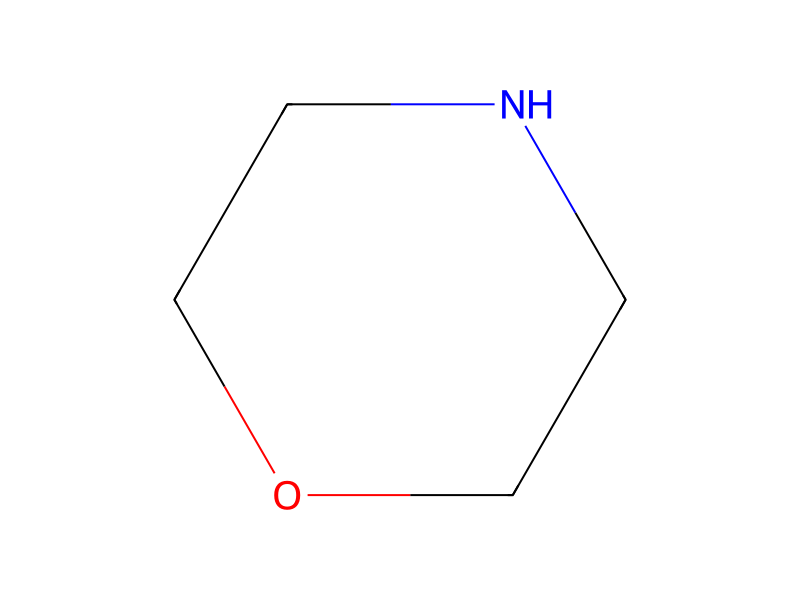
A reaction mixture consisting of 2.63 gm. (0.01 mole) 4-(p-chlorophenyl)-4-dimethylaminocyclohexanone (prepared as in Preparation I, Part i, above), 0.87 ml. morpholine, 0.05 gm. para-toluenesulfonic acid, and 40 ml. benzene is heated at the reflux temperature for seven (7) hours in a reaction vessel fitted with a Dean and Stark trap. The benzene is then removed by evaporation under reduced pressure. The residue thus obtained is dissolved in 10 ml. tetrahydrofuran, to which solution is added 0.76 gm. (0.02 mole) sodium borohydride in 35.0 ml. absolute ethanol. This reaction mixture is heated at the reflux temperature for seventeen (17) hours, after which heating the tetrahydrofuran and ethanol are removed by evaporation under pressure. The residue thus obtained is dispersed in a mixture of water and diethyl ether. After vigorous shaking and allowing the aqueous and organic phases to separate, the organic phase is recovered. It is washed first with water and then with brine. The ether is then allowed to evaporate. The residue thus obtained is transferred onto a 1 inch by 4 foot column of silica gel averaging 20 to 50 microns in size, for purposes of high pressure liquid chromatographic (HPLC) purification. The chromatogram is developed with a solvent system consisting of 5% methanol in chloroform with 1% triethylamine. The fractions of eluate containing the object compound yield a solid which is recrystallized from aqueous methanol to give 0.95 gm. (30% yield) of 1-(p-chlorophenyl)-1-dimethylamino-4-morpholinocyclohexane having a melting point at 103° to 105° C.