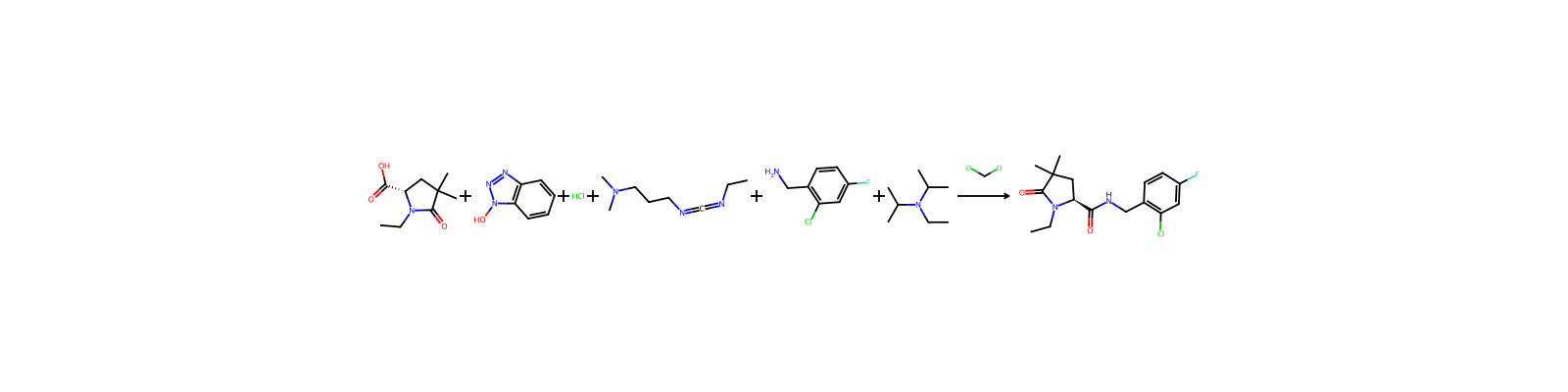
1-ethyl-4,4-dimethyl-5-oxoproline (0.130 g, 0.702 mmol, prepared as described below), 1-Hydroxybenzotriazole (0.161 g, 1.053 mmol), and N-(3-dimethylaminopropyl)-N′-ethylcarbodiimide hydrochloride (0.202 g, 1.053 mmol) were dissolved in dichloromethane (5 ml) and stirred for 15 minutes at room temperature. [(2-chloro-4-fluorophenyl)methyl]amine (0.134 g, 0.842 mmol) and diisopropylethylamine (0.184 ml, 1.053 mmol) were then added to the mixture and stirring continued overnight at room temperature. The mixture was then concentrated in vacuo and the residue partitioned between ethyl acetate and water and extracted with ethyl acetate. The combined organic layers were washed sequentially with 3N citric acid, water, saturated aqueous sodium carbonate, water (×3), and then brine and dried over anhydrous sodium sulfate. Concentration gave a crude solid which was subsequently purified by mass-directed automated HPLC to give N-[(2-chloro-4-fluorophenyl)methyl]-1-ethyl-4,4-dimethyl-5-oxoprolinamide (0.146 g) as a solid. LC/MS [M+H]+=327/329, retention time=2.35 minutes.