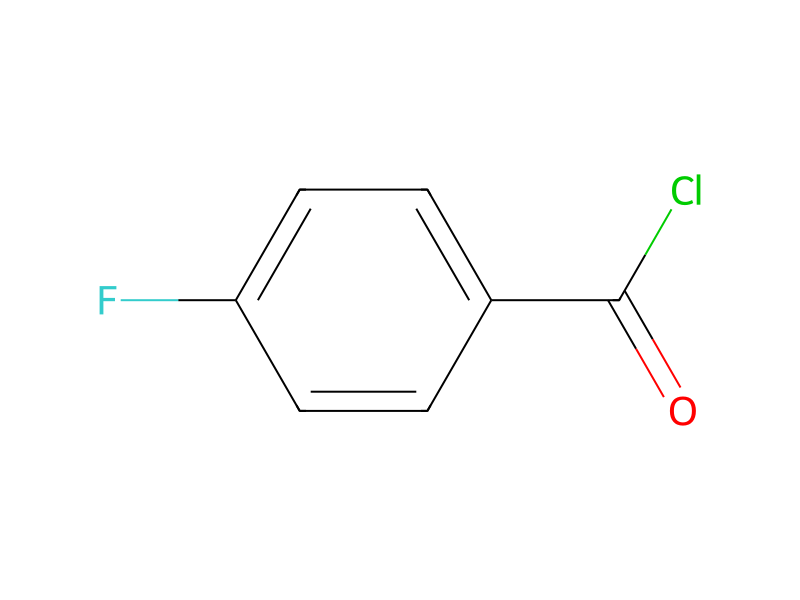
Para-aminocinnamic acid hydrochloride (0.1 mol, 19.96 g) was dissolved in 100 milliliters (ml) of dimethylacetamide and 30 ml pyridine, then 0.1 mol of para-fluorobenzoylchloride was added dropwise while the solution was maintained at 0° C. The solution was allowed to react for about 5 hours at room temperature, and then neutralized to a pH of 6 to 7 with hydrochloric acid. The solution was filtered to obtain a reaction intermediate. The intermediate was washed with water, dried under a vacuum and recrystallized in a solution of dimethylacetamide (10%) and water (90%). A yield of 90% N (para-fluorbenzoyl)-para-aminocinnamic acid in was obtained. Thionyl chloride (1.2 equivalents) and 50 ml of methylene chloride were added. The solution was allowed to react until clear. After the reaction, the solvent and thionyl chloride were removed under a vacuum, and the remaining product was dried. N-(para-fluorbenzoyl)- para-aminocinnamic acid was obtained.