Reaction equation
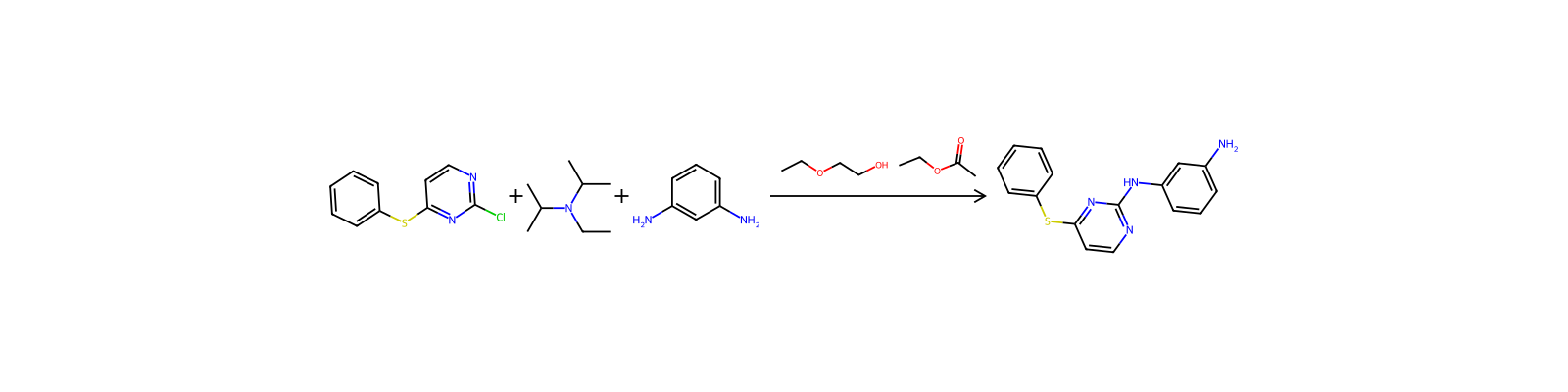
Cl[C:2]1[N:7]=[C:6]([S:8][C:9]2[CH:14]=[CH:13][CH:12]=[CH:11][CH:10]=2)[CH:5]=[CH:4][N:3]=1.C(N(C(C)C)CC)(C)C.[C:24]1([NH2:31])[CH:29]=[CH:28][CH:27]=[C:26]([NH2:30])[CH:25]=1>C(OCCO)C.C(OCC)(=O)C>[C:9]1([S:8][C:6]2[CH:5]=[CH:4][N:3]=[C:2]([NH:30][C:26]3[CH:27]=[CH:28][CH:29]=[C:24]([NH2:31])[CH:25]=3)[N:7]=2)[CH:14]=[CH:13][CH:12]=[CH:11][CH:10]=1Participants
6





Procedure
To a stirred mixture of 2-chloro-4-(phenylthio)pyrimidine (300 mg, 1.35 mmol) and diisopropylethylamine (0.35 mL, 2.02 mmol) in 2-ethoxyethanol (2 mL), was added 1,3-phenylenediamine (291 mg, 2.70 mmol) in one portion. The whole was heated under reflux for 20 hours. The mixture was cooled to room temperature, diluted with ethyl acetate (20 mL), washed with water and brine. The organic solution was dried (Na2SO4), concentrated in vacuo. The residue was flash chromatographed on silica gel using ethyl acetate:petroleum ether (20:80→50:50) as eluant to give the product (167 mg, 42%).
Workup
- temperatureThe whole was heated
- temperatureunder reflux for 20 hours
- washwashed with water and brine
- dry with materialThe organic solution was dried (Na2SO4)
- concentrationconcentrated in vacuo
- customchromatographed on silica gel
Sources & evidence
- ORD record
- ord-a2fff81be1694ddd90762a623013500b
- Source dataset
- uspto-grants-2015_05
- Patent number
- US09040549B2
Linked notes
Loading…