Reaction equation

Br[C:2]1[CH:3]=[CH:4][C:5]([N+:8]([O-:10])=[O:9])=[N:6][CH:7]=1.[NH:11]1[CH2:16][CH2:15][O:14][CH2:13][CH2:12]1.C(=O)([O-])[O-].[K+].[K+]>[I-].C([N+](CCCC)(CCCC)CCCC)CCC.CS(C)=O.C(OCC)(=O)C>[N+:8]([C:5]1[N:6]=[CH:7][C:2]([N:11]2[CH2:16][CH2:15][O:14][CH2:13][CH2:12]2)=[CH:3][CH:4]=1)([O-:10])=[O:9]Participants
7


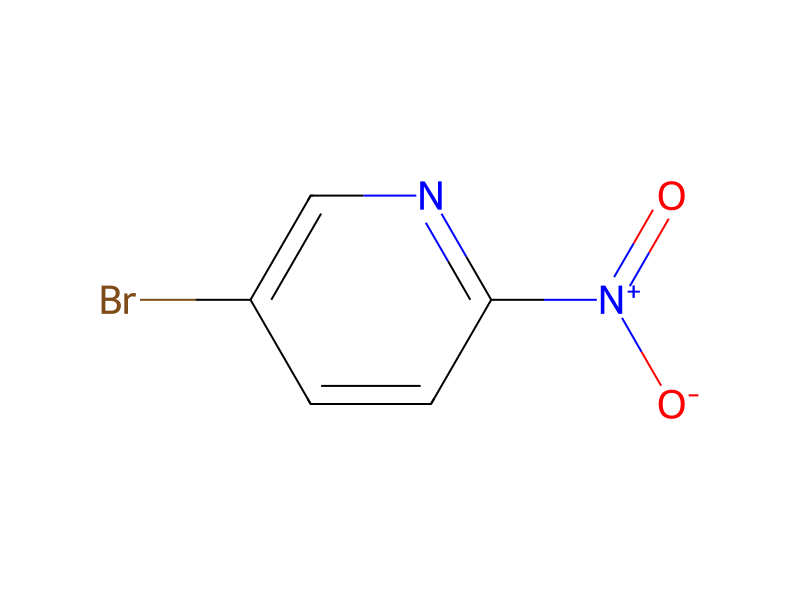




Conditions
- Temperature
- 80 °C
Procedure
5-Bromo-2-nitropyridine (5.14 g, 25.3 mmol), tetra-n-butyl ammonium iodide (0.467 g, 1.27 mmol), morpholine (2.43 g, 27.9 mmol) and potassium carbonate (3.85 g, 27.9 mmol) were mixed in DMSO (50 mL). The reaction mixture was warmed to 80° C. for 15 hours. The reaction mixture was diluted with ethyl acetate and the solids removed by filtration. The organic filtrate was washed with water, then the solvent evaporated. The residue was then triturated with a dichloromethane/hexanes mixture to provide 4-(6-nitro-pyridin-3-yl)-morpholine as brown needles (2.90 g, 54.8%). 1H NMR δ (400 MHz, CDCl3) 8.16 (m, 1H), 7.97 (d, J=2.9 Hz, 1H), 7.15 (dd, J=3.2, 9.3 Hz, 1H), 3.45 (m, 4H), 1.72 (m, 4H).
Workup
- customthe solids removed by filtration
- washThe organic filtrate was washed with water
- customthe solvent evaporated
- customThe residue was then triturated with a dichloromethane/hexanes mixture
Sources & evidence
- ORD record
- ord-37fe36c73def478fa5119c4c399ed3e8
- Source dataset
- uspto-grants-2005_08
- Patent number
- US06936612B2
Linked notes
Loading…