HomeMCPWorkbenchSkills
HomeWorkbenchNotificationsMe
llms.txt · MCP GuidePrivacy Policy · Terms of Service · Supportv1.8.3
  1. Home
  2. /Reaction

Nitrogen → 2-(5-Chloro-pyridin-3-yl)-indole-1-carboxylic acid tert-butyl ester

HRID 593573
Print

Reaction equation

HRID 593573 reaction equation
[C:1]([N:8]1[C:16]2[C:11](=[CH:12][CH:13]=[CH:14][CH:15]=2)[CH:10]=[C:9]1B(O)O)([O:3][C:4]([CH3:7])([CH3:6])[CH3:5])=[O:2].[Cl:20][C:21]1[CH:22]=[N:23][CH:24]=[C:25](Br)[CH:26]=1.COC1C=CC=C(OC)C=1C1C=CC=CC=1P(C1CCCCC1)C1CCCCC1.P([O-])([O-])([O-])=O.[K+].[K+].[K+].N#N>C1C=CC(/C=C/C(/C=C/C2C=CC=CC=2)=O)=CC=1.C1C=CC(/C=C/C(/C=C/C2C=CC=CC=2)=O)=CC=1.C1C=CC(/C=C/C(/C=C/C2C=CC=CC=2)=O)=CC=1.[Pd].[Pd].C1(C)C=CC=CC=1>[C:4]([O:3][C:1]([N:8]1[C:16]2[C:11](=[CH:12][CH:13]=[CH:14][CH:15]=2)[CH:10]=[C:9]1[C:25]1[CH:24]=[N:23][CH:22]=[C:21]([Cl:20])[CH:26]=1)=[O:2])([CH3:7])([CH3:6])[CH3:5]


ParticipantsProcedureWorkupSources & evidenceReaction notes

Participants

8

Reactant 5

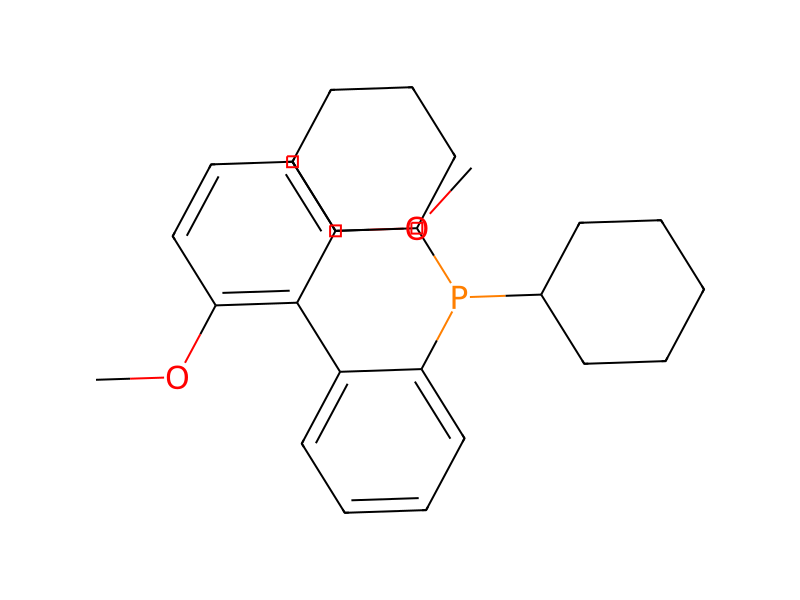
HCID 947NitrogenHCID 62657Potassium Phosphate, TribasicHCID 6062563-Bromo-5-chloropyridineHCID 27733021-(tert-Butoxycarbonyl)indole-2-boronic Acid (contains varying amounts of Anhydride)HCID 112698722-Dicyclohexylphosphino-2',6'-dimethoxybiphenyl

Product 1

HCID 67093544
2-(5-Chloro-pyridin-3-yl)-indole-1-carboxylic acid tert-butyl ester

Reagents, catalysts & solvents 2

HCID 9811564Bis(dibenzylideneacetone)palladiumCatalystHCID 1140TolueneSolvent

Procedure

A flask is charged with N-Boc-indole-2-boronic acid (0.407 g, 1.55 mmol), 3-chloro-5-bromopyridine (0.200 g, 1.03 mmol), s-phos (0.021 g, 0.05 mmol), potassium phosphate (0.441 g, 2.07 mmol) and toluene (5 mL). The flask is evacuated and filled with N2 thrice and Pd2(dba)3 (0.019 g, 0.02 mmol) is added. The flask is evacuated and filled with N2 thrice. The mixture is refluxed for 1 h, then cooled to room temperature and filtered through celite. The filtrate is concentrated in vacuo to afford 2-(5-chloro-pyridin-3-yl)-indole-1-carboxylic acid tert-butyl ester as an oil. The residue is dissolved in DCM (5 mL) and trifluoroacetic acid (2 mL) is added. The reaction mixture is stirred at room temperature for 4 h, followed with quenching with a saturated sodium bicarbonate solution. Extraction with dichloromethane, drying of the organic layer over sodium sulfate and concentration in vacuo gives a residue which is purified by silica gel flash chromatography (heptane-ethyl acetate, 3:2) to afford 2-(5-chloro-pyridin-3-yl)-1H-indole. 1H NMR (400 MHz, MeOD) δ ppm 7.06 (s, 1H), 7.08 (d, J=7.8 Hz, 1H), 7.20 (t, J=7.7 Hz, 1H), 7.45 (d, J=8.3 Hz, 1H), 7.61 (d, J=7.8 Hz, 1H), 8.30 (t, J=2.1 Hz, 1H), 8.47 (d, J=2.3 Hz, 1H), 8.96 (d, J=1.8 Hz, 2H). HRMS (ESI) m/z 229.0542 [(M+H)+ calcd for C13H10ClN2: 229.0533].

Workup

  1. customThe flask is evacuated
  2. additionis added
  3. customThe flask is evacuated
  4. additionfilled with N2 thrice
  5. temperatureThe mixture is refluxed for 1 h
  6. filtrationfiltered through celite
  7. concentrationThe filtrate is concentrated in vacuo

Sources & evidence

ORD record
ord-6b101b9a76f34df1b1cbd36ab18aba58
Source dataset
uspto-grants-2016_01
DOI
10.6084/m9.figshare.5104873.v1
Patent number
US09242963B2

Reaction notes

On this pageParticipantsProcedureWorkupSources & evidenceReaction notes