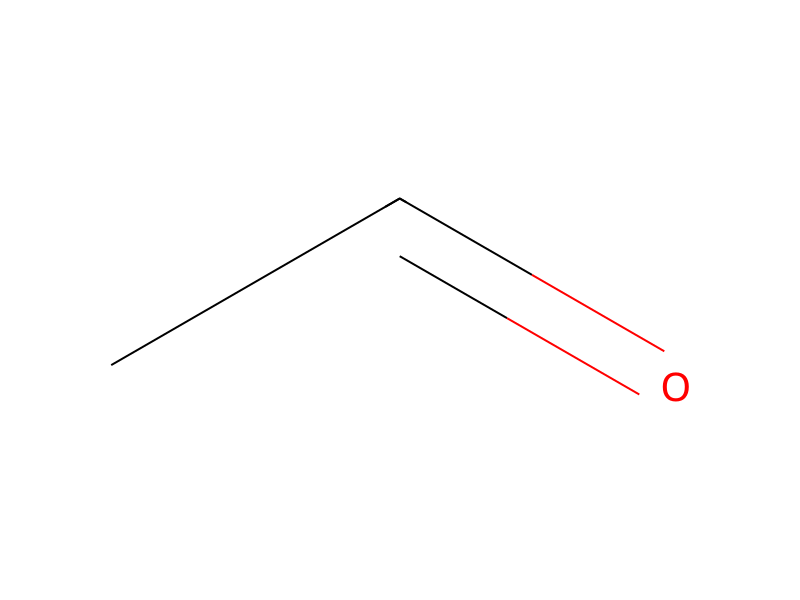
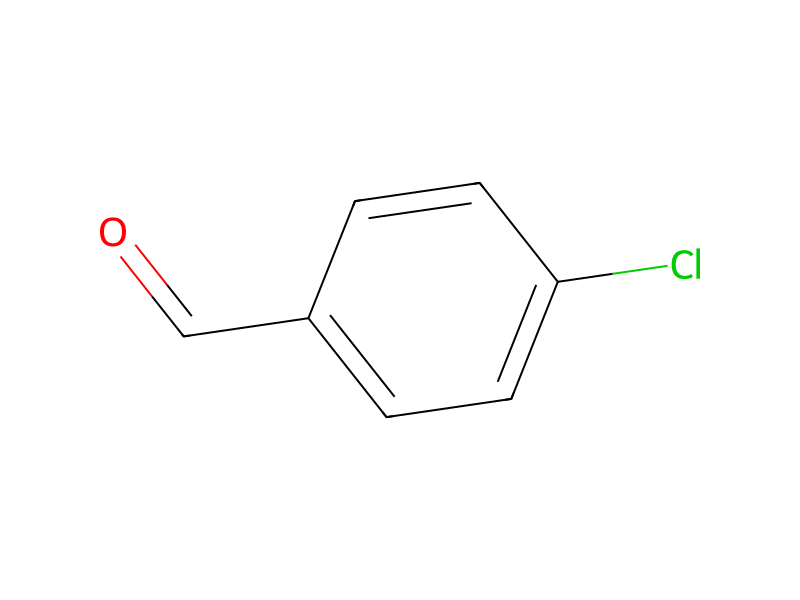
Acetaldehyde → 3-(4-Chlorophenyl)prop-2-enenitrile
Reaction equation

[NH2:1]O.[Cl:3][C:4]1[CH:13]=[CH:12][C:7]([CH:8]=[CH:9][CH:10]=[O:11])=[CH:6][CH:5]=1.ClC1C=CC(C=O)=CC=1.CC=O>CCO>[Cl:3][C:4]1[CH:13]=[CH:12][C:7]([CH:8]=[CH:9][C:10]#[N:1])=[CH:6][CH:5]=1.[Cl:3][C:4]1[CH:5]=[CH:6][C:7]([CH:8]=[CH:9][CH:10]=[O:11])=[CH:12][CH:13]=1Participants




Procedure
Hydroxylamine hydrochloride (13.0 g.) was dissolved in dry methanol (100 ml.) and neutralised to phenolphthalein with a solution of sodium (6 g.) in methanol (60 ml.). The precipitated sodium chloride was filtered off and the filtrate was refluxed with p-chlorocinnamonitrile (9.4 g.) for 2 hrs. Thin layer chromatography showed the reaction to be complete after this time. The reaction mixture was evaporated to dryness in vacuo and the residue was crystallised from ethanol to produce colourless of crystals of p-chlorocinnamamidoxime, 4.16 g. (37%) m.p. 102°-4° λmax (EtOH), 273 nm., ε17500, τ(CDCl3) 2.68 (aromatic), 3.00 (OH), 5.16 (NH2), 3.13 (doublet, J=16 c./sec.), 3.58 (doublet, J=16 c./sec.). p-Chlorocinnamonitrile was prepared by NH2OH treatment and dehydrations of p-chlorocinnamaldehyde (J. Chem. Soc., 1965, 1564). p-Chlorocinnamaldehyde was prepared from p-chloro benzaldehyde and CH3CHO cf. G. Cigarella, E. Occelli, and E. Testa, (J. Med. Chem., 1965, 8, 326).
Sources & evidence
- ORD record
- ord-003e2bfb769e43eeaefbdb815ce032c9
- Source dataset
- uspto-grants-1977_03
- Patent number
- US04012377
Reaction notes
Loading…