Reaction equation
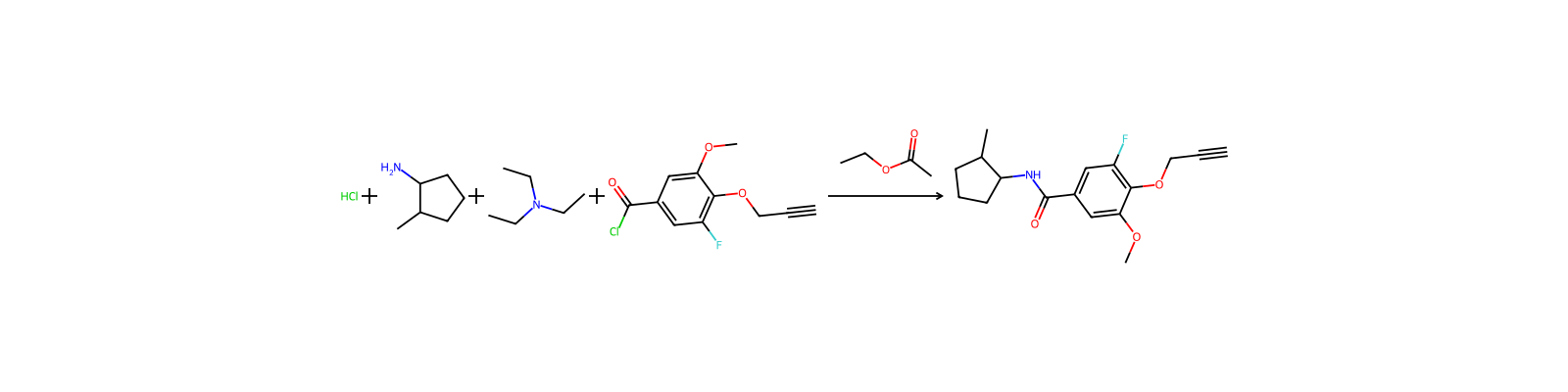
Cl.[CH3:2][CH:3]1[CH2:7][CH2:6][CH2:5][CH:4]1[NH2:8].C(N(CC)CC)C.[F:16][C:17]1[CH:18]=[C:19]([CH:23]=[C:24]([O:30][CH3:31])[C:25]=1[O:26][CH2:27][C:28]#[CH:29])[C:20](Cl)=[O:21]>C(OCC)(=O)C>[CH3:2][CH:3]1[CH2:7][CH2:6][CH2:5][CH:4]1[NH:8][C:20](=[O:21])[C:19]1[CH:23]=[C:24]([O:30][CH3:31])[C:25]([O:26][CH2:27][C:28]#[CH:29])=[C:17]([F:16])[CH:18]=1Participants
5
Reactant 3



Product 1

Reagents, catalysts & solvents 1

Procedure
To a mixture of 1 ml of ethyl acetate and 0.2 g of 2-methylcyclopentylamine hydrochloride was added 0.48 ml of triethylamine and then, a mixture of 0.24 g of 3-fluoro-5-methoxy-4-(2-propynyloxy)benzoyl chloride and 1 ml of ethyl acetate was added dropwise thereto under ice cooling. The mixture obtained was stirred at room temperature for 12 hours. Then, the reaction mixture was concentrated under reduced pressure. The residue obtained was subjected to silica gel column chromatography to obtain 0.21 g of N-(2-methylcyclopentyl)-3-fluoro-5-methoxy-4-(2-propynyloxy)benzamide (hereinafter, described as the compound 70 of the present invention) represented by the formula:
Workup
- additionwas added dropwise
- customThe mixture obtained
- concentrationThen, the reaction mixture was concentrated under reduced pressure
- customThe residue obtained
Sources & evidence
- ORD record
- ord-af8ac2f70c564e48a2e22ca7b8e5209f
- Source dataset
- uspto-grants-2011_03
- Patent number
- US07902400B2
Linked notes
Loading…