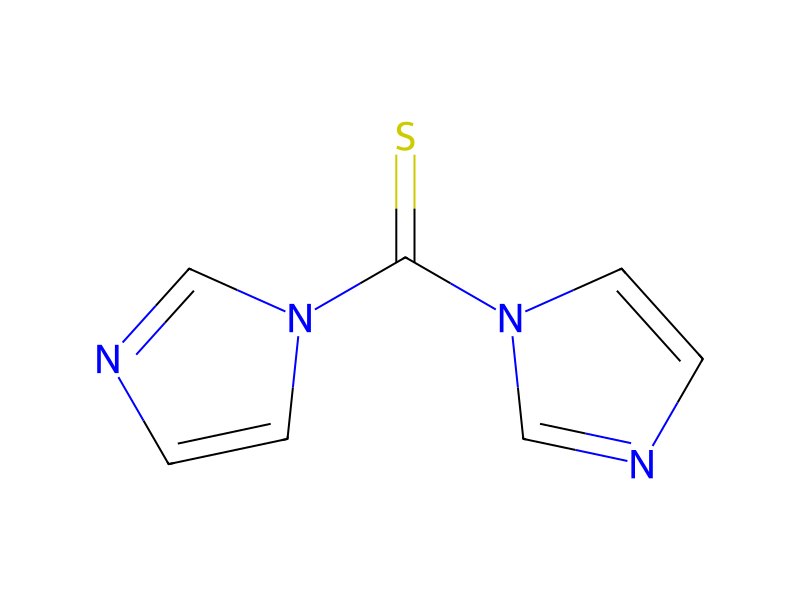
C(N1C=CN=C1)(N1C=CN=C1)=S.[CH3:13][N:14]1[CH2:19][CH2:18][NH:17][CH2:16][CH2:15]1.[NH2:20][C:21](N)=[S:22].Br[CH2:25][C:26]([C:28]1[CH:36]=[CH:35][C:31]([C:32]([OH:34])=[O:33])=[CH:30][CH:29]=1)=O>C1COCC1.CCO>[CH3:13][N:14]1[CH2:19][CH2:18][N:17]([C:21]2[S:22][CH:25]=[C:26]([C:28]3[CH:36]=[CH:35][C:31]([C:32]([OH:34])=[O:33])=[CH:30][CH:29]=3)[N:20]=2)[CH2:16][CH2:15]1To thiocarbonyldiimidazole (2 g, 11.5 mmol) in THF (30 mL) at RT was added N-methylpiperazine (1.00 g, 10 mmol) drop wise. The reaction was stirred at RT for 2 h and then at 55° C. for 1 h. The reaction was cooled to RT and 20 mL of THF was removed in vacuo. 2M NH3 (10 mL) in MeOH was added and the reaction stirred for 15 h. A further 2M NH3 (10 mL) in MeOH was added and the reaction maintained at 55° C. for 8 h. A pale yellow precipitate (1.00 g) was observed and filtered off, dried and used directly in the next step. The thiourea (0.84 g, 5.2 mmol) was dissolved in EtOH (30 mL) and 4-(2-bromo-acetyl)-benzoic acid (1.28 g, 5.2 mmol) was added. The reaction was heated at reflux for 3 h. The reaction was cooled to RT and the solid filtered off. The solid was washed with Et2O and dried thoroughly. This procedure provided the title compound as a pale yellow solid (1.23 g, 77%).