HomeMCPWorkbenchSkills
HomeWorkbenchNotificationsMe
llms.txt · MCP GuidePrivacy Policy · Terms of Service · Supportv1.8.0
  1. Home
  2. /Reaction

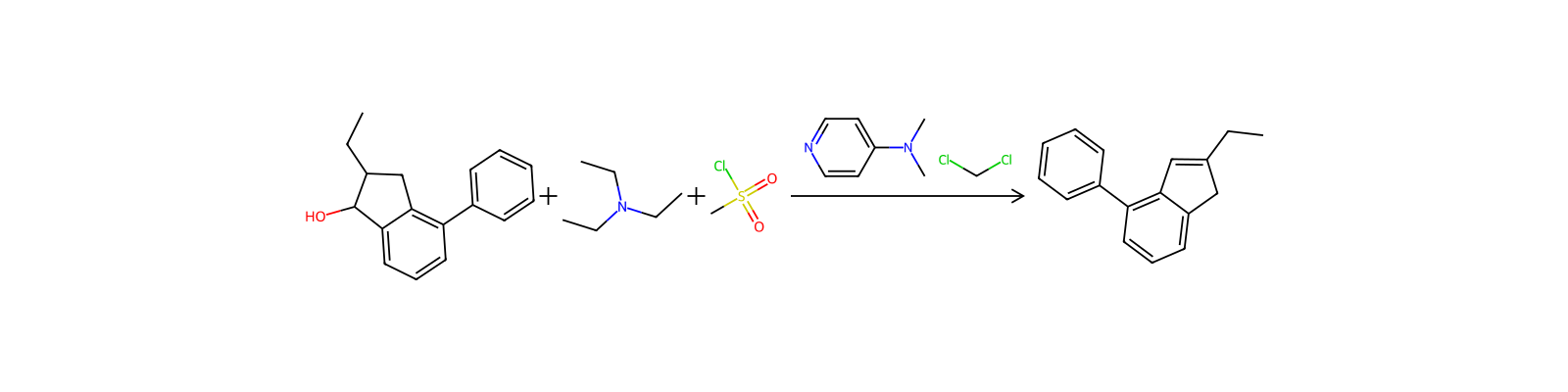
Triethylamine → 2-ethyl-4-phenyl-1H-indene

HRID 609519
Notes
Print preview

Reaction equation

HRID 609519 reaction equation
[CH2:1]([CH:3]1[CH2:11][C:10]2[C:5](=[CH:6][CH:7]=[CH:8][C:9]=2[C:12]2[CH:17]=[CH:16][CH:15]=[CH:14][CH:13]=2)[CH:4]1O)[CH3:2].C(N(CC)CC)C.CS(Cl)(=O)=O>CN(C)C1C=CN=CC=1.C(Cl)Cl>[CH2:1]([C:3]1[CH2:4][C:5]2[C:10]([CH:11]=1)=[C:9]([C:12]1[CH:17]=[CH:16][CH:15]=[CH:14][CH:13]=1)[CH:8]=[CH:7][CH:6]=2)[CH3:2]
ParticipantsProcedureWorkupSources & evidenceReaction notes

Participants

6

Reactant 3

HCID 8471TriethylamineHCID 31297Methanesulfonyl chlorideHCID 223402152-Ethyl-1-hydroxy-4-phenylindan

Product 1

HCID 178307842-ethyl-4-phenyl-1H-indeneYield 72.1%

Reagents, catalysts & solvents 2

HCID 142844-(Dimethylamino)pyridineCatalyst
HCID 6344
Dichloromethane
Solvent
2×

Procedure

To a 300-ml four-necked round flask (equipped with a stirrer tip, a dropping funnel and a thermometer) were introduced 9.78 g (41.3 mmol) of 2-ethyl-1-hydroxy-4-phenylindan, 17.2 ml (123.8 mmol) of triethylamine, 0.25 g (2.1 mmol) of 4-dimethylaminopyridine and 98 ml of methylene chloride, and then in a nitrogen atmosphere under ice cooling, a solution of 6.4 ml (82.5 mmol) of methanesulfonyl chloride in 6.5 ml of methylene chloride was dropwise added slowly. After the dropwise addition was completed, the reaction was performed for further 3.5 hours at the same temperature. The reaction mixture was poured into 250 ml of ice water, the organic phase was separated, and the aqueous phase was extracted twice with 50 ml of methylene chloride. The combined organic phases were washed with a saturated NaHCO3 aqueous solution and then with a saturated saline solution, followed by drying over anhydrous Na2SO4. The solvent was distilled off under reduced pressure, and the residue was purified by silica gel chromatography using hexane to obtain 6.56 g of the aimed product (a mixture of isomers) as a light yellow liquid (yield: 73%). The properties of the product thus obtained are described below.

Workup

  1. customTo a 300-ml four-necked round flask (equipped with a stirrer tip, a dropping funnel
  2. additionAfter the dropwise addition
  3. customthe organic phase was separated
  4. extractionthe aqueous phase was extracted twice with 50 ml of methylene chloride
  5. washThe combined organic phases were washed with a saturated NaHCO3 aqueous solution
  6. dry with materialby drying over anhydrous Na2SO4
  7. distillationThe solvent was distilled off under reduced pressure
  8. customthe residue was purified by silica gel chromatography

Sources & evidence

ORD record
ord-4daad2cc5fc248529c67dc5501cbe798
Source dataset
uspto-grants-1999_12
DOI
10.6084/m9.figshare.5104873.v1
Patent number
US05998039

Reaction notes

Loading…

On this pageParticipantsProcedureWorkupSources & evidenceReaction notes

