Reaction equation

[CH2:1]([N:3]1[C:12]2[C:7](=[CH:8][C:9]([F:19])=[C:10]([N:13]3[CH2:18][CH2:17][NH:16][CH2:15][CH2:14]3)[CH:11]=2)[C:6](=[O:20])[C:5]([C:21]([OH:23])=[O:22])=[CH:4]1)[CH3:2]>[OH-].[Na+].C(O)(=O)C>[OH2:20].[OH2:20].[OH2:20].[OH2:20].[OH2:20].[CH2:1]([N:3]1[C:12]2[C:7](=[CH:8][C:9]([F:19])=[C:10]([N:13]3[CH2:18][CH2:17][NH:16][CH2:15][CH2:14]3)[CH:11]=2)[C:6](=[O:20])[C:5]([C:21]([OH:23])=[O:22])=[CH:4]1)[CH3:2]Participants
4
Reactant 1

Product 1
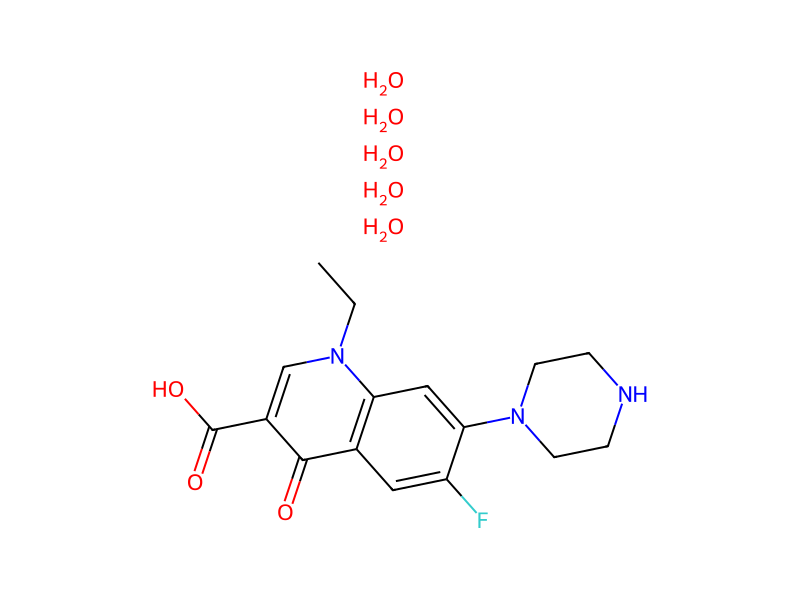
Reagents, catalysts & solvents 2


Procedure
The compound (II) was dissolved in 10% sodium hydroxide and neutralized with acetic acid. The precipitate was washed with water and dried at room temperature to afford 1-ethyl-6-fluoro-1,4-dihydro-7-(1-piperazinyl)-4-oxoquinoline-3-carboxylic acid hydrate (I) as colorless powder, m.p.: 226°-227° C.
Workup
- washThe precipitate was washed with water
- customdried at room temperature
Sources & evidence
- ORD record
- ord-cd84b54551eb4287bbcf73cd49f6b746
- Source dataset
- uspto-grants-1979_03
- Patent number
- US04146719
Linked notes
Loading…