Acrylic Acid → Acrylic acid vinylpyrrolidone
HRID 619984
Reaction equation

[C:1]([OH:5])(=[O:4])[CH:2]=[CH2:3].[CH:6]([N:8]1[CH2:12][CH2:11][CH2:10][C:9]1=[O:13])=[CH2:7]>C(O)(C)C>[C:1]([OH:5])(=[O:4])[CH:2]=[CH2:3].[CH:6]([N:8]1[CH2:12][CH2:11][CH2:10][C:9]1=[O:13])=[CH2:7]Participants
4
Reactant 2

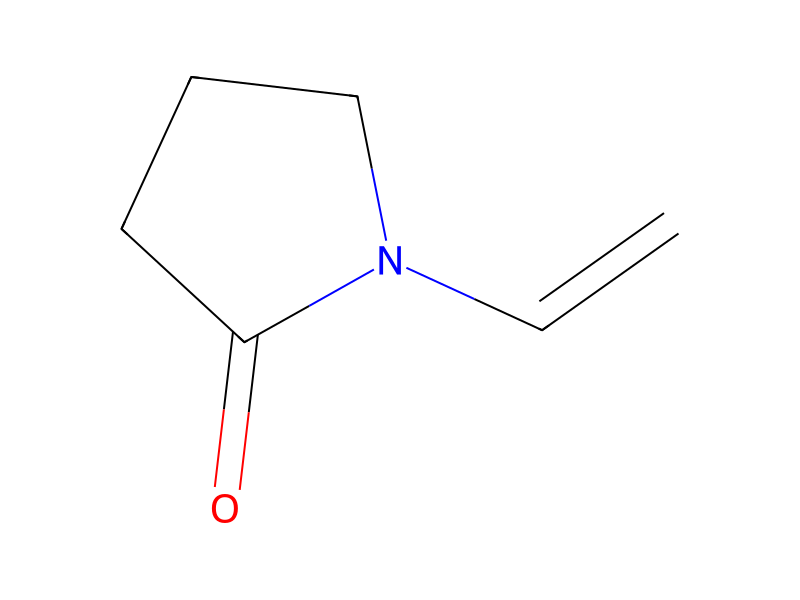
Product 1

Reagents, catalysts & solvents 1

Conditions
- Temperature
- 82 °C
Procedure
A 74/26 poly(acrylic acid/N-vinylpyrrolidone) was prepared by adding 21.7 grams of acrylic acid, 8.3 grams of N-vinylpyrrolidone and 267.0 grams of isopropanol to a reaction vessel. The monomer solution was heated to 82° C. reflux temperature with nitrogen purging. Aftr purging was complete 3.0 grams of t-butyl peroctoate was immediately added to the mixture and refluxing was continued for about 2.5 hours longer. The reaction mixture was left to cool, forming some precipitate. The entire reaction mixture including precipitate and solution was then concentrated on a rotary evaporator to form a fluffy white solid. Final drying was done in a vacuum oven at 1 mm Hg vacuum for three hours at 60° C. The procedure yielded a dry weight product of 34 grams. The product had a molecular weight of 5930 (aq.) and was 75.9 percent active. The copolymer was tested according to the procedures of Example 1 and showed a 99 percent gypsum scale inhibition.