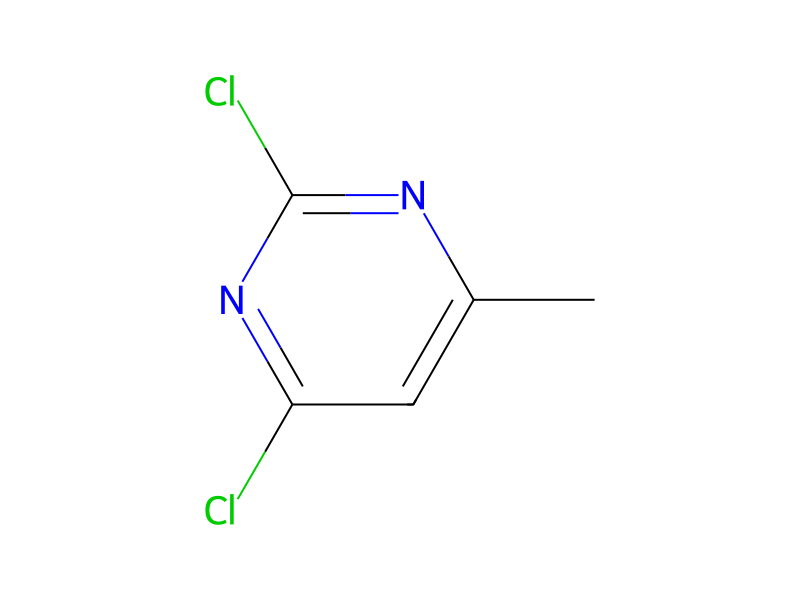
[Cl:1][C:2]1[N:7]=[C:6](Cl)[CH:5]=[C:4]([CH3:9])[N:3]=1.Cl.[C:11]1([C:17]2[CH2:18][CH2:19][NH:20][CH2:21][CH:22]=2)[CH:16]=[CH:15][CH:14]=[CH:13][CH:12]=1.C(N(C(C)C)CC)(C)C.C(=O)([O-])O.[Na+]>C(O)C>[C:11]1([C:17]2[CH2:22][CH2:21][N:20]([C:6]3[CH:5]=[C:4]([CH3:9])[N:3]=[C:2]([Cl:1])[N:7]=3)[CH2:19][CH:18]=2)[CH:16]=[CH:15][CH:14]=[CH:13][CH:12]=1In 4 ml of ethanol was dissolved 415 mg of 2,4-dichloro-6-methylpyrimidine, and the solution was cooled with ice-water. To the solution were added 503 mg of 4-phenyl-1,2,3,6-tetrahydropyridine hydrochloride and 664 mg of diisopropylethylamine, followed by stirring overnight under cooling with ice. The reaction solution was poured into a saturated aqueous solution of sodium hydrogencarbonate and extracted with ethyl acetate. The extract was washed with a saturated aqueous sodium chloride solution and dried over anhydrous sodium sulfate. The desiccant was removed by filtration, the filtrate was concentrated under reduced pressure, and the residue was purified by silica gel column chromatography (developing solvent: hexane/ethyl acetate=10/1 to 3/1) to give 491 mg of 4-(4-phenyl-1,2,3,6-tetrahydropyridin-1-yl)-2-chloro-6-methylpyrimidine as crystals.
Loading…