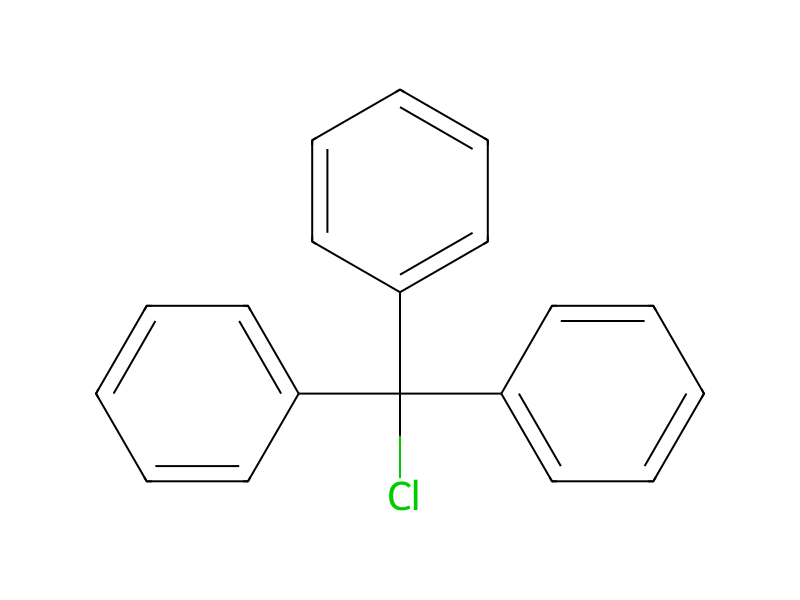
C([O:3][C:4](=[O:11])[CH2:5][C:6]1[N:7]=[N:8][NH:9][N:10]=1)C.[C:12](Cl)([C:25]1[CH:30]=[CH:29][CH:28]=[CH:27][CH:26]=1)([C:19]1[CH:24]=[CH:23][CH:22]=[CH:21][CH:20]=1)[C:13]1[CH:18]=[CH:17][CH:16]=[CH:15][CH:14]=1.O.[OH-].[K+]>C1COCC1.C(O)C>[C:12]([N:8]1[N:9]=[N:10][C:6]([CH2:5][C:4]([OH:3])=[O:11])=[N:7]1)([C:13]1[CH:18]=[CH:17][CH:16]=[CH:15][CH:14]=1)([C:25]1[CH:26]=[CH:27][CH:28]=[CH:29][CH:30]=1)[C:19]1[CH:20]=[CH:21][CH:22]=[CH:23][CH:24]=1To a mixture of (2H-tetrazol-5-yl)-acetic acid ethyl ester (2.0 g, 12.81 mmol), trityl chloride (3.7 g, 13.45 mmol) in dry THF (75 ml) was added TEA (3.7 ml). The resulting mixture was stirred for 18 hrs. at room temperature. Water (10 ml) was added and the precipitate filtered off, redissolved in EtOAc (25 ml) and washed with saturated aqueous ammonium chloride (2×15 ml). The organic phase was dried (Na2SO4), filtered and evaporated in vacuo. The residue was suspended in ethanol (150 ml) and potassium hydroxide (0.8 g, 13.45 mmol) dissolved in ethanol (100 ml) was added. The resulting mixture was stirred for 18 hrs. at room temperature. The precipitate was filtered off and dissolved in water (150 ml) and acidified with conc. HCl (use diluted HCl). The precipitate was filtered off and washed with diethyl ether and dried in vacuo at 50° C. affording 0.7 g (15%) of (2-trityl-2H-tetrazol-5-yl)-acetic acid as a solid.
Loading…