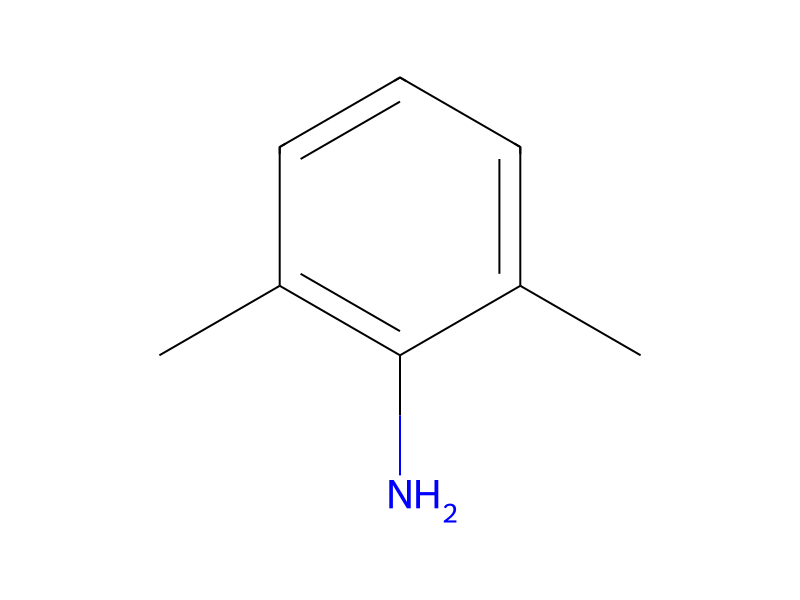
[CH3:1][C:2]1[CH:7]=[C:6]([CH3:8])[N:5]2[N:9]=[C:10]([S:12](Cl)(=[O:14])=[O:13])[N:11]=[C:4]2[N:3]=1.[CH3:16][C:17]1[CH:23]=[CH:22][CH:21]=[C:20]([CH3:24])[C:18]=1[NH2:19].N1C=CC=CC=1>CN(C1C=CN=CC=1)C.C(Cl)Cl>[CH3:1][C:2]1[CH:7]=[C:6]([CH3:8])[N:5]2[N:9]=[C:10]([S:12]([NH:19][C:18]3[C:20]([CH3:24])=[CH:21][CH:22]=[CH:23][C:17]=3[CH3:16])(=[O:14])=[O:13])[N:11]=[C:4]2[N:3]=1A solution of 2.2. g (8.9 mmol) of 5,7-dimethyl-1,2,4-triazolo[1,5-a]pyrimidine-2-sulfonyl chloride, 1.01 ml (8.4 mmol) of 2,6-dimethylaniline, 0.7 ml (8.4 mmol) of dry pyridine and 4 mg of DMAP in 20 ml of CH2Cl2 was stirred at room temperature for 17 hours. The solvent was removed by evaporation and the residue was taken up in 0.5M NaOH. The solution was extracted with diethyl ether and the aqueous phase was acidified with 3N HCl to precipitate a solid. The solid was collected by filtration and dried in vacuo to yield 2.72 g (97 percent) of the desired product as a white solid, m.p. 263°-266° C. (decomp.): 1H NMR (DMSO-d6) δ10.4 (1H, broad s), 7.55 (1H, s), 7.2 (3H, s), 2.7 and 2.8 (3H each, s) and 2.1 (6H, s); IR (KBr) 3100, 2980-2780, 1628, 1540 and 1355 cm-1.
Loading…