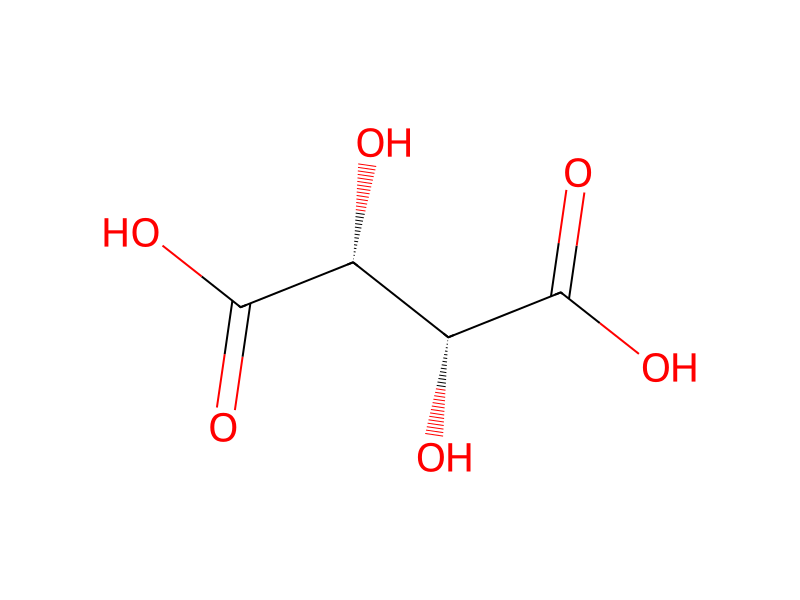
While stirring, 18.54 g (100 mmole) of tri-n-butylamine was added drop by drop to 7.50 g (50 mmole) of L-(+)-tartaric acid, which was dissolved in 50 ml of water, whereby the solution was heated to 30° C. Subsequently, 18.81 g (100 mmole) of 3-chloro-2-hydroxy-propyltrimethylammonium chloride, which was dissolved in 100 ml of water, was added to the solution. The resultant clear solution was extracted with 8 separate portions of 150 ml of methylene chloride. The extractions were evaporated under vacuum. 21.65 g (97.6 percent yield) of tributylamine hydrochloride was obtained. (Together, the two last extractions only still contained 0.14 g of material.) The aqueous layer was evaporated in a rotary evaporator until dry. 23.22 g of a very viscous oil (102.5 percent) resulted. This was dissolved hot in 30 ml of methanol. It was mixed slowly with 93 ml of acetone until it became cloudy. The latter was again made to disappear by the addition of a few drops of methanol. After 72 hours, the mother liquor was decanted. The crystal crust was washed with acetone/methanol (3:1) and was dried under vacuum. The yield was 7.20 g of crystals (31.8 percent or 63.6 percent of the theory). The crystals had a melting point of 147° to 170° C. The crude tartrate was dissolved in 10 g of hot methanol and gradually 45 ml of acetone were added, whereupon the crystallization immediately started. The crystallization vessel was kept overnight in the refrigerator. The mother liquor was decanted off; the crystal cake was washed with acetone and dried. 5.78 g of crystals, corresponding to 51 percent of the theory, were obtained. The crystals had a melting point of 150° to 152° C. and a [α]D24 of -7.5° (c=1.04 in water). The tributylamine was recovered from the methylene chloride residue (raw tributylamine hydrochloride) with a yield of 96 percent by placing the residue in a solution of methylene chloride, shaking the solution with 1N of caustic soda solution and removing the solvent under vacuum.