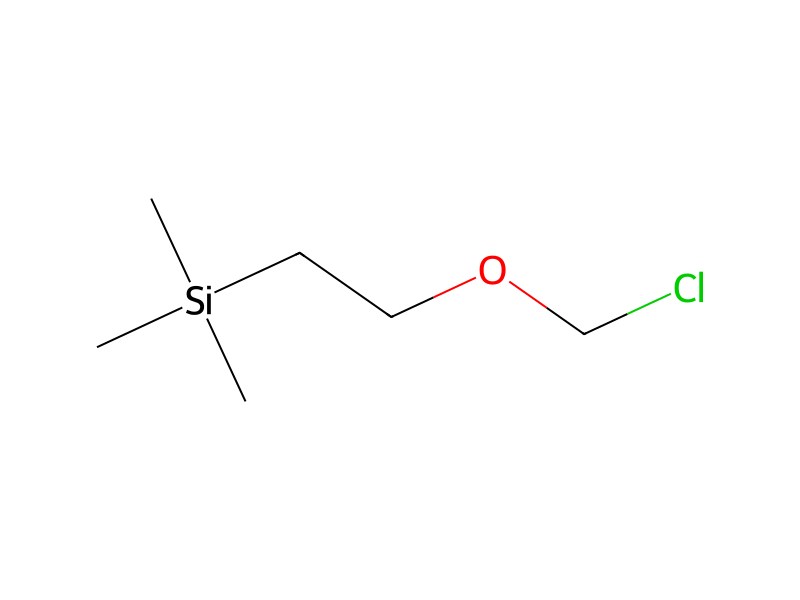
[NH:1]1[C:5]2=[N:6][CH:7]=[CH:8][CH:9]=[C:4]2[C:3]([CH:10]=[O:11])=[CH:2]1.[H-].[Na+].Cl[CH2:15][O:16][CH2:17][CH2:18][Si:19]([CH3:22])([CH3:21])[CH3:20]>CN(C=O)C>[CH3:20][Si:19]([CH3:22])([CH3:21])[CH2:18][CH2:17][O:16][CH2:15][N:1]1[C:5]2=[N:6][CH:7]=[CH:8][CH:9]=[C:4]2[C:3]([CH:10]=[O:11])=[CH:2]1To a solution of 1H-pyrrolo[2,3-B]pyridine-3-carbaldehyde (2.0 g, 13.7 mmol) in 20 mL DMF at 0° C. was added NaH (328 mg, 13.7 mmol). The suspension was allowed to stir at 0° C. for 30 min, then [2-(chloromethoxy)ethyl](trimethyl)silane (2.67 mL, 15.1 mmol) was slowly added. The reaction was allowed to warm to ambient temperature and stirred for 16 h. The mixture was concentrated and partitioned between saturated NaHCO3 and CH2Cl2. The organics were washed with water and brine, then dried over Na2SO4, filtered and concentrated. The crude solid was triturated with CH2Cl2 and filtered. The filtrate was concentrated and purified by silica gel chromatography (0-25% ethylacetate/hexanes) to give 1-{[2-(trimethylsilyl)ethoxy]methyl}-1H-pyrrolo[2,3-b]pyridine-3-carbaldehyde (66%). LCMS [M+H]+=277.1.
Loading…