Reaction equation

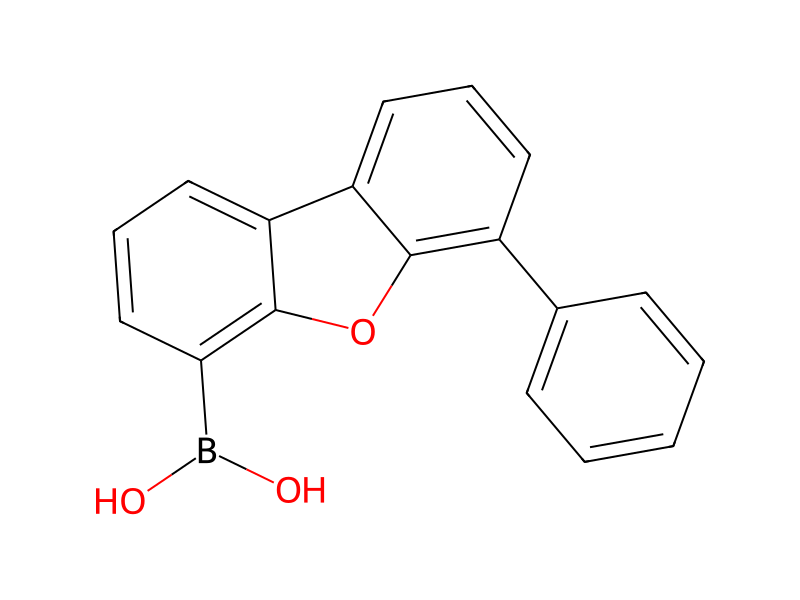
C([Li])CCC.[C:6]1([C:12]2[C:17]3[O:18][C:19]4[CH:24]=[CH:23][CH:22]=[CH:21][C:20]=4[C:16]=3[CH:15]=[CH:14][CH:13]=2)[CH:11]=[CH:10][CH:9]=[CH:8][CH:7]=1.[B:25](OC)([O:28]C)[O:26]C.[NH4+].[OH-]>C1COCC1>[C:6]1([C:12]2[C:17]3[O:18][C:19]4[C:24]([B:25]([OH:28])[OH:26])=[CH:23][CH:22]=[CH:21][C:20]=4[C:16]=3[CH:15]=[CH:14][CH:13]=2)[CH:7]=[CH:8][CH:9]=[CH:10][CH:11]=1Participants
6





Procedure
n-Butyllithium (13.51 mL, 33.8 mmol) was added dropwise to 4-phenyldibenzo[b,d]furan (3.3 g, 13.51 mmol) in 80 mL dry THF at −78° C. This reaction mixture was allowed to stir at room temperature for 5 hours and then cooled to −78° C. again. Trimethyl borate (4.52 mL, 40.5 mmol) was added slowly to the reaction. The reaction mixture was allowed to warm up to room temperature gradually over night with stirring. The mixture was poured into 50 mL of NH4OH solution with ice. The aqueous mixture was extracted with 3×80 mL ethyl acetate and dried over sodium sulfate, and the organic layer was evaporated to get yield 3.3 g (85%) product, which was used without purification and was confirmed by NMR.
Workup
- temperaturecooled to −78° C. again
- temperatureto warm up to room temperature gradually over night
- stirringwith stirring
- extractionThe aqueous mixture was extracted with 3×80 mL ethyl acetate
- dry with materialdried over sodium sulfate
- customthe organic layer was evaporated
Sources & evidence
- ORD record
- ord-d772e11d94504c63bfd97bfe1f6ec880
- Source dataset
- uspto-grants-2015_11
- Patent number
- US09193745B2
Linked notes
Loading…