Dimethylformamide → HCID 10893859, compound
Reaction equation

[N+:1]([C:4]1[CH:5]=[CH:6][C:7]2[O:11][C:10]([C:12]([OH:14])=O)=[CH:9][C:8]=2[CH:15]=1)([O-:3])=[O:2].CN(C=O)C.C(N(C(C)C)CC)(C)C.[NH2:30][C:31]1[CH:32]=[C:33]2[C:37](=[CH:38][CH:39]=1)[NH:36][C:35]([C:40]([OH:42])=[O:41])=[CH:34]2>>[N+:1]([C:4]1[CH:5]=[CH:6][C:7]2[O:11][C:10]([C:12]([NH:30][C:31]3[CH:32]=[C:33]4[C:37](=[CH:38][CH:39]=3)[NH:36][C:35]([C:40]([OH:42])=[O:41])=[CH:34]4)=[O:14])=[CH:9][C:8]=2[CH:15]=1)([O-:3])=[O:2]Participants
5


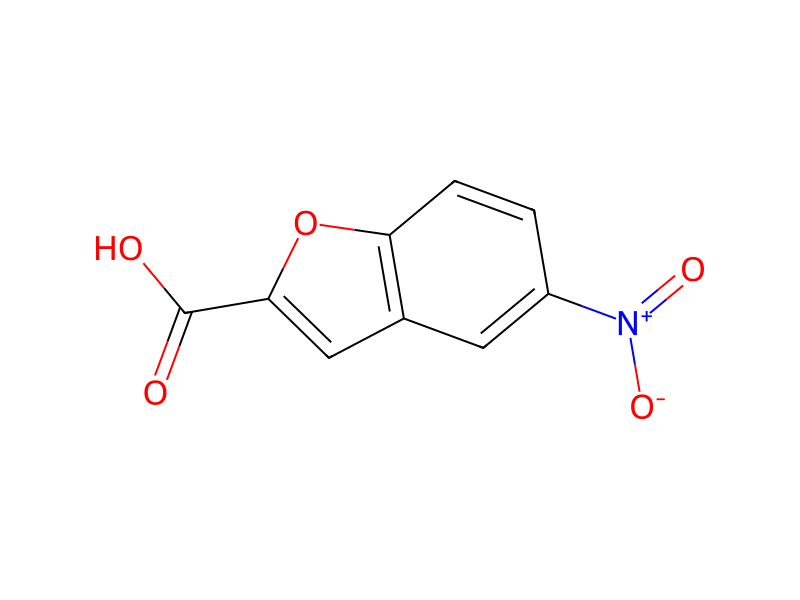


Procedure
To the solution of 93.2 mg (0.45 mmol) 5-nitrobenzofuran-2-carboxylic acid (128) in 6 mL DMF 209.0 mg (0.45 mmol) PyBroP and 157 μL (0.9 mmol) diisopropylethylamine was added and the clear solution was stirred for 10 minutes at room temperature. The activated acid was transferred to resin 127 which was agitated for 5 hrs. The resin was drained, washed twice with DMF. The analytical sample showed no complete reaction and therefore the activation/coupling reaction was repeated once again the same way using fresh reagents. The resin was drained, washed five times with DMF to give 129 which was used immediately as described in Example 117.