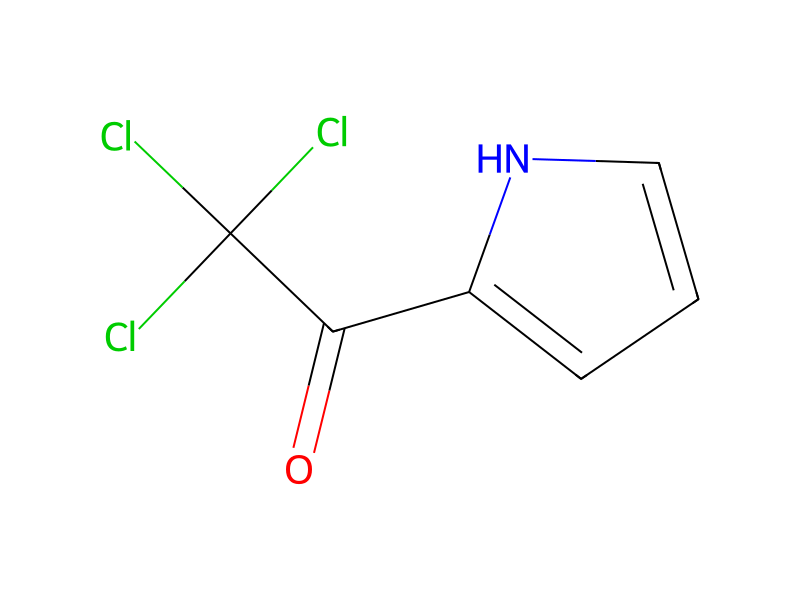
[Cl:1][C:2]([Cl:11])([Cl:10])[C:3]([C:5]1[NH:6][CH:7]=[CH:8][CH:9]=1)=[O:4].C(OC(=O)C)(=O)C.[N+:19]([O-])([OH:21])=[O:20].C(=O)(O)[O-].[Na+]>C(O)(=O)C>[N+:19]([C:7]1[NH:6][C:5]([C:3](=[O:4])[C:2]([Cl:1])([Cl:10])[Cl:11])=[CH:9][CH:8]=1)([O-:21])=[O:20]21.3 g (0.1 mol) of 2-trichloroacetylpyrrole and 100 ml of acetic anhydride were introduced into a round-bottomed flask. At 0° C., a solution of 4.2 ml of fuming nitric acid, 8 ml of acetic acid and 8 ml of acetic anhydride was added dropwise and the temperature was permitted to increase to room temperature. The reaction medium was poured into ice, the pH adjusted to 8 with sodium bicarbonate, extracted with dichloromethane, the organic phase decanted off, dried over magnesium sulfate and evaporated. The residue obtained was purified by chromatography on a silica column eluted with a mixture of dichloromethane and hexane (60-40). There were recovered 5.5 g (21%) of 5-nitro-2-trichloroacetylpyrrole in the form of a dark green oil and 11.2 g of 4-nitro-2-trichloroacetylpyrrole of melting point 160°-163° C.