HomeMCPWorkbenchSkills
HomeWorkbenchNotificationsMe
llms.txt · MCP GuidePrivacy Policy · Terms of Service · Supportv1.8.0
  1. Home
  2. /Reaction

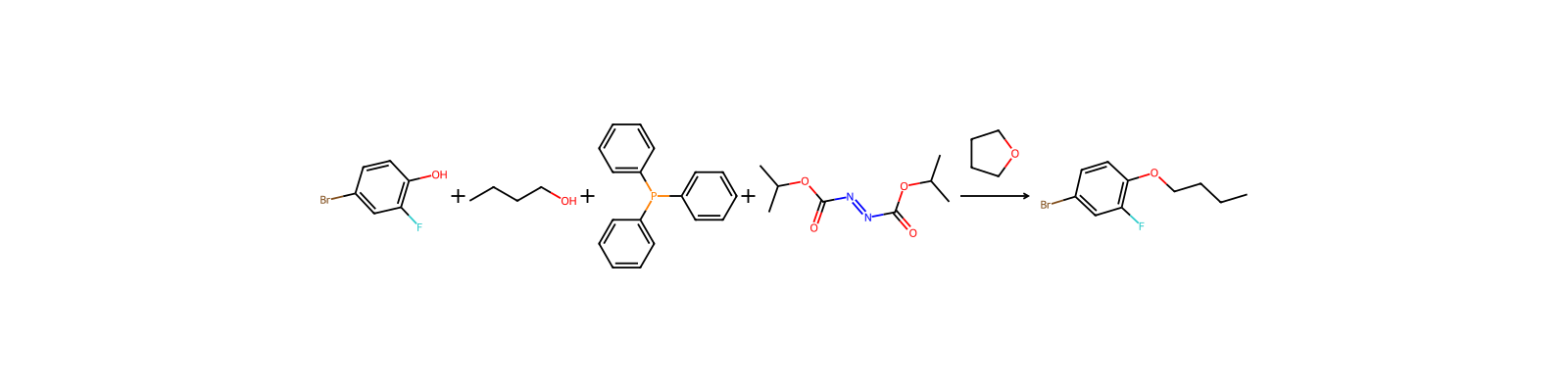
1-Butanol → 4-Bromo-1-butoxy-2-fluorobenzene

HRID 7332
Notes
Print preview

Reaction equation

HRID 7332 reaction equation
[Br:1][C:2]1[CH:7]=[CH:6][C:5]([OH:8])=[C:4]([F:9])[CH:3]=1.[CH2:10](O)[CH2:11][CH2:12][CH3:13].C1(P(C2C=CC=CC=2)C2C=CC=CC=2)C=CC=CC=1.N(C(OC(C)C)=O)=NC(OC(C)C)=O>O1CCCC1>[Br:1][C:2]1[CH:7]=[CH:6][C:5]([O:8][CH2:10][CH2:11][CH2:12][CH3:13])=[C:4]([F:9])[CH:3]=1
ParticipantsProcedureWorkupSources & evidenceReaction notes

Participants

6

Reactant 4

HCID 2631-ButanolHCID 11776TriphenylphosphineHCID 75555Diisopropyl diazene-1,2-dicarboxylateHCID 27249814-Bromo-2-fluorophenol

Product 1

HCID 120674454-Bromo-1-butoxy-2-fluorobenzeneYield 95.6%

Reagents, catalysts & solvents 1

HCID 8028
On this pageParticipantsProcedureWorkupSources & evidenceReaction notes
Tetrahydrofuran
Solvent

Procedure

0.315 mol of each of 4-bromo-2-fluorophenol (1), 1-butanol and triphenylphosphine were dissolved in 1000 ml of tetrahydrofuran, and 0.315 mol of diisopropyl azodicarboxylate was added dropwise at about 20° C. After the mixture had been stirred overnight, the solvent was removed by distillation in a rotary evaporator, and the residue was subjected to conventional work-up, giving the compound (2) in a yield of 95.6% of theory.

Workup

  1. customthe solvent was removed by distillation in a rotary evaporator

Sources & evidence

ORD record
ord-d7098213ef994e7f871969c33d7d6733
Source dataset
uspto-grants-2006_08
DOI
10.6084/m9.figshare.5104873.v1
Patent number
US07087272B2

Reaction notes

Loading…