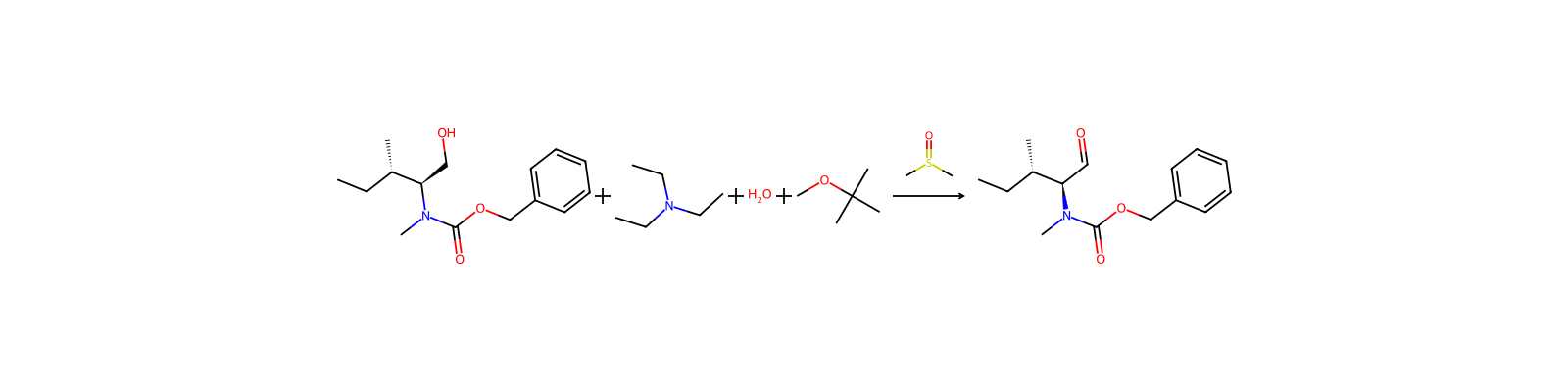
To a solution of #1 (8.27 g, 31.2 mmol, 1 eq.) in dimethyl sulfoxide (41.35 mL, 0.75 M), was added triethylamine (8.70 mL, 64.0 mmol, 2.05 eq.) and the mixture was cooled to 0° C. Sulfur trioxide pyridine complex (10.18 g, 63.96 mmol, 2.05 eq.) was then added portion-wise, while keeping the internal temperature below 8° C. The reaction was allowed to reach room temperature and was stirred for 18 hours. The reaction was poured into water (100 mL) and tert-butyl methyl ether (100 mL). The aqueous layer was back-extracted with tert-butyl methyl ether (50 mL) and the combined organic layers were washed with brine (100 mL), dried over magnesium sulfate, filtered, concentrated in vacuo and purified by silica gel chromatography (Gradient: 10% to 60% ethyl acetate in heptane) to provide #2 (7.14 g, 87%) as a colorless oil. 1H NMR (400 MHz, DMSO-d6), presumed to be a mixture of rotamers, characteristic signals: δ 9.61 (s, 1H), 7.26-7.42 (m, 5H), 5.01-5.13 (m, 2H), 4.04-4.12 (m, 1H), 2.86 and 2.82 (2 s, total 3H), 1.94-2.11 (br m, 1H), 1.26-1.42 (br m, 1H).