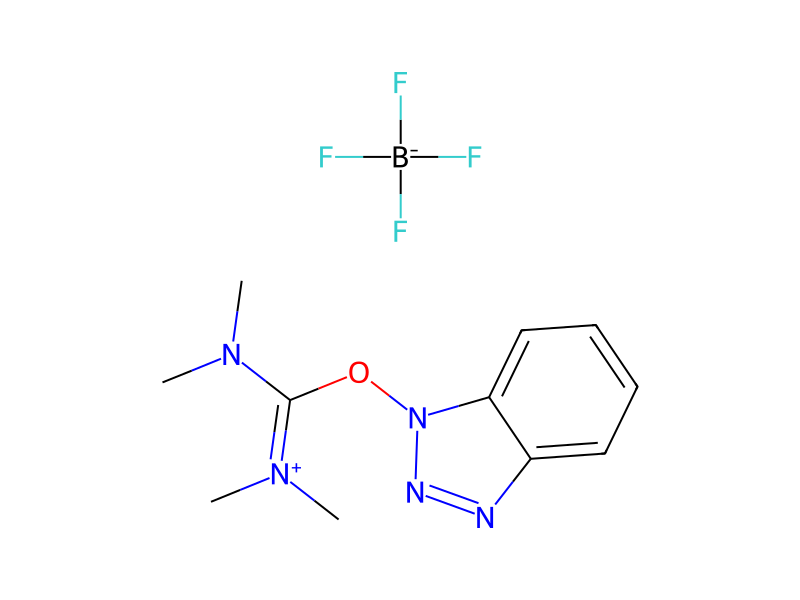
To a solution of 4-hydroxy-1-methyl-1H-indole-2-carboxylic acid (Example 10, 0.12 g) in DMF (10 mL) was added TBTU (0.20 g), HOBt (0.10 g) and DIEA (0.35 mL). After 5 min., 4-(dimethylamino)benzylamine dihydrochloride (0.14 g) was added and stirring was continued overnight under nitrogen at room temperature. The residue remaining after DMF evaporation was purified by reversed phased chromatography on C18 silica with a trifluoroacetic acid (0.025%) acidified acetonitrile water gradient to give 0.14 g of the title compound. MS ES (M++H)=324.