Reaction equation
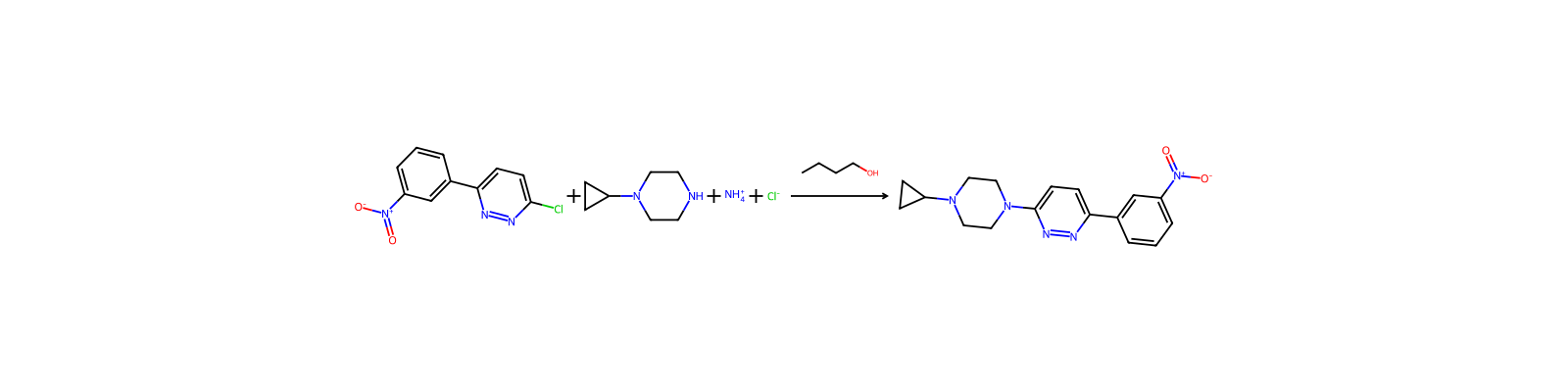
Cl[C:2]1[N:3]=[N:4][C:5]([C:8]2[CH:13]=[CH:12][CH:11]=[C:10]([N+:14]([O-:16])=[O:15])[CH:9]=2)=[CH:6][CH:7]=1.[CH:17]1([N:20]2[CH2:25][CH2:24][NH:23][CH2:22][CH2:21]2)[CH2:19][CH2:18]1.[NH4+].[Cl-]>CCCCO>[CH:17]1([N:20]2[CH2:25][CH2:24][N:23]([C:2]3[N:3]=[N:4][C:5]([C:8]4[CH:13]=[CH:12][CH:11]=[C:10]([N+:14]([O-:16])=[O:15])[CH:9]=4)=[CH:6][CH:7]=3)[CH2:22][CH2:21]2)[CH2:19][CH2:18]1Participants
5




Conditions
- Temperature
- 80 °C
Procedure
To a solution of 3-chloro-6-(3-nitro-phenyl)-pyridazine (10.0 g, 424 mmol) in n-BuOH (150 mL) was added 1-cyclopropyl-piperazine (8.55 g, 678 mmol) and NH4Cl (2.27 g, 424 mmol) and the mixture was stirred for 48 h at 80° C. The solvent was removed under reduced pressure, and the residue was diluted with water. After alkalization with ammonia, the mixture was extracted with ethyl acetate. The extract was dried (Na2SO4) and concentrated to give 7.2 g of crude 3-(4-cyclopropyl-piperazin-1-yl)-6-(3-nitro-phenyl)-pyridazine.
Workup
- customThe solvent was removed under reduced pressure
- additionthe residue was diluted with water
- extractionAfter alkalization with ammonia, the mixture was extracted with ethyl acetate
- dry with materialThe extract was dried (Na2SO4)
- concentrationconcentrated
Sources & evidence
- ORD record
- ord-3666725acd2842338bbe8900b1198449
- Source dataset
- uspto-grants-2014_09
- Patent number
- US08846677B2
Linked notes
Loading…