Reaction equation
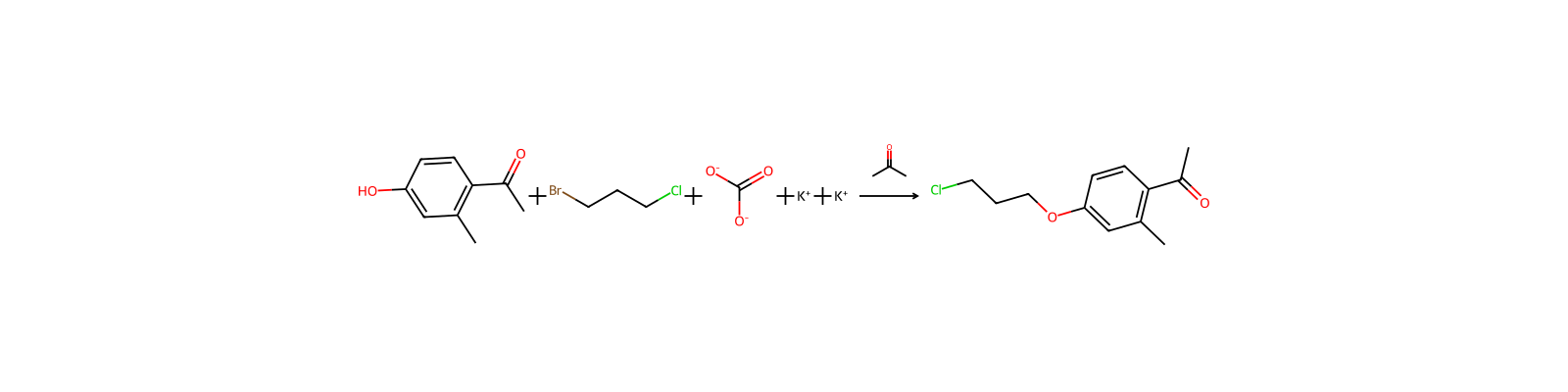
[OH:1][C:2]1[CH:7]=[CH:6][C:5]([C:8](=[O:10])[CH3:9])=[C:4]([CH3:11])[CH:3]=1.Br[CH2:13][CH2:14][CH2:15][Cl:16].C(=O)([O-])[O-].[K+].[K+]>CC(C)=O>[CH3:11][C:4]1[CH:3]=[C:2]([O:1][CH2:13][CH2:14][CH2:15][Cl:16])[CH:7]=[CH:6][C:5]=1[C:8](=[O:10])[CH3:9]Participants
Reactant 3



Product 1

Reagents, catalysts & solvents 1

Conditions
- Temperature
- 50 °C
Procedure
A mixture of 4′-hydroxy-2′-methyl-acetophenone (10.5 g) and 1-bromo-3-chloropropane (7.6 mL) in acetone (70 mL) was treated with potassium carbonate (14.5 g). The mixture was stirred at 50° C. for approximately 18 hours. The reaction mixture was cooled to ambient temperature and partitioned between dichloromethane (200 mL) and water (200 mL). The aqueous layer was washed twice with fresh portions of dichloromethane (200 mL) and brine was used to break any emulsions. The organic fractions were combined, dried over sodium sulfate, and evaporated. The residue was re-dissolved in dichloromethane (100 mL) and washed with 0.5 M sodium hydroxide (100 mL) and brine (100 mL), dried over magnesium sulfate, filtered and evaporated to give the title compound which was used without further purification.
Workup
- temperatureThe reaction mixture was cooled to ambient temperature
- custompartitioned between dichloromethane (200 mL) and water (200 mL)
- washThe aqueous layer was washed twice with fresh portions of dichloromethane (200 mL) and brine
- dry with materialdried over sodium sulfate
- customevaporated
- dissolutionThe residue was re-dissolved in dichloromethane (100 mL)
- washwashed with 0.5 M sodium hydroxide (100 mL) and brine (100 mL)
- dry with materialdried over magnesium sulfate
- filtrationfiltered
- customevaporated
Sources & evidence
- ORD record
- ord-d09efd5bbd8744ae90df923aa5ef3ad5
- Source dataset
- uspto-grants-2006_08
- Patent number
- US07087757B2
Linked notes
Loading…