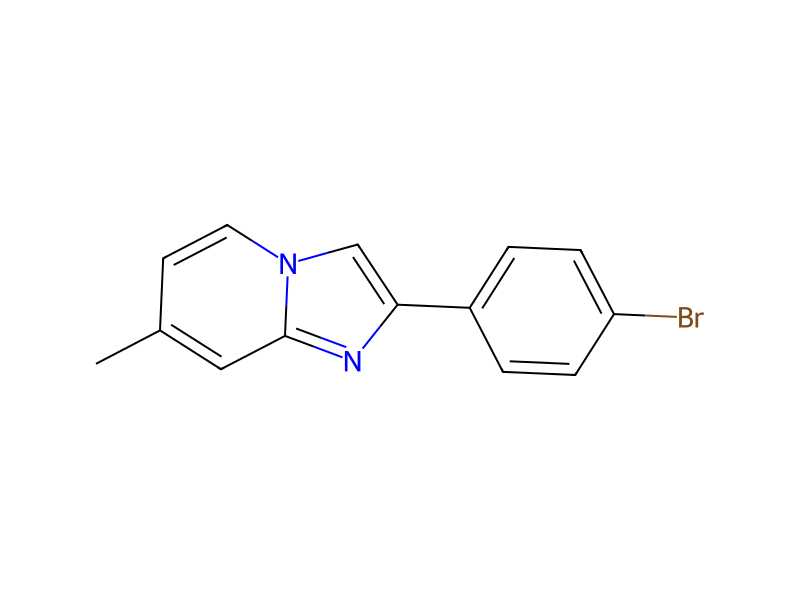
Triethylamine → 2-[4-[4-Hydroxybut-1-ynyl]phenyl]-7-methylimidazo[1,2-a]pyridine
Reaction equation

Br[C:2]1[CH:7]=[CH:6][C:5]([C:8]2[N:9]=[C:10]3[CH:15]=[C:14]([CH3:16])[CH:13]=[CH:12][N:11]3[CH:17]=2)=[CH:4][CH:3]=1.C(N(CC)CC)C.[CH2:25]([OH:29])[CH2:26][C:27]#[CH:28]>C(#N)C.C1C=CC([P]([Pd]([P](C2C=CC=CC=2)(C2C=CC=CC=2)C2C=CC=CC=2)([P](C2C=CC=CC=2)(C2C=CC=CC=2)C2C=CC=CC=2)[P](C2C=CC=CC=2)(C2C=CC=CC=2)C2C=CC=CC=2)(C2C=CC=CC=2)C2C=CC=CC=2)=CC=1.[Cu]I>[OH:29][CH2:25][CH2:26][C:27]#[C:28][C:2]1[CH:7]=[CH:6][C:5]([C:8]2[N:9]=[C:10]3[CH:15]=[C:14]([CH3:16])[CH:13]=[CH:12][N:11]3[CH:17]=2)=[CH:4][CH:3]=1Participants
7