Reaction equation
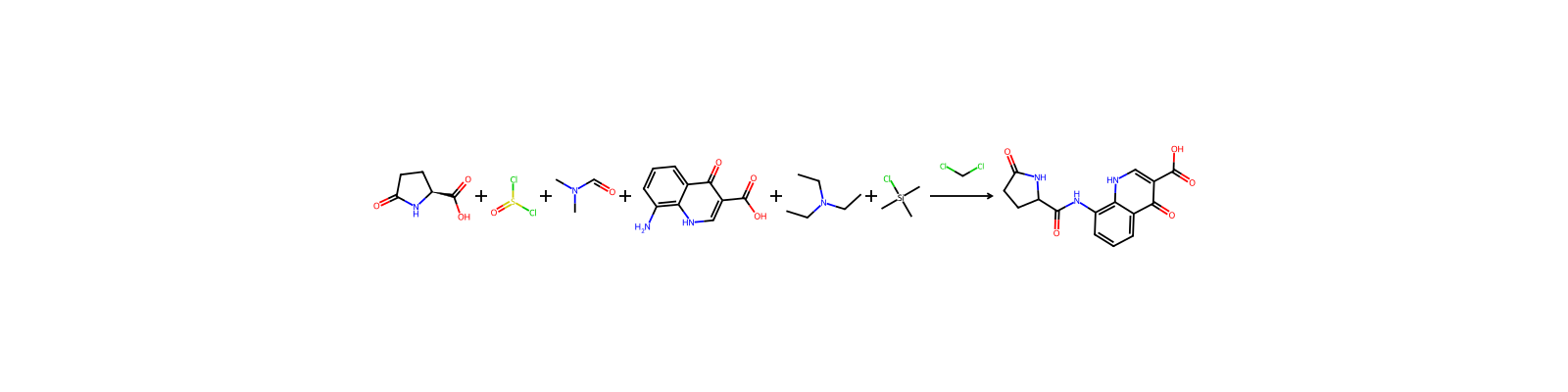
[O:1]=[C:2]1[NH:6][C@H:5]([C:7]([OH:9])=O)[CH2:4][CH2:3]1.S(Cl)(Cl)=O.CN(C)C=O.[NH2:19][C:20]1[CH:21]=[CH:22][CH:23]=[C:24]2[C:29]=1[NH:28][CH:27]=[C:26]([C:30]([OH:32])=[O:31])[C:25]2=[O:33].C(N(CC)CC)C.Cl[Si](C)(C)C>ClCCl>[O:33]=[C:25]1[C:24]2[C:29](=[C:20]([NH:19][C:7]([CH:5]3[CH2:4][CH2:3][C:2](=[O:1])[NH:6]3)=[O:9])[CH:21]=[CH:22][CH:23]=2)[NH:28][CH:27]=[C:26]1[C:30]([OH:32])=[O:31]Participants
Reactant 6






Product 1

Reagents, catalysts & solvents 1

Procedure
A mixture of 3.87 g (30 mmol) of 5-oxo-L-proline, 2.19 ml (30 mmol) of thionyl chloride, 2.32 ml (30 mmol) of dimethylformamide, and 75 ml of dichloromethane is stirred with cooling for 1 hour. A mixture of 4.08 g (20 mmol) 8-amino-1,4-dihydro-4-oxo-3-quinolinecarboxylic acid, 8.4 ml (60 mmol) of triethylamine, 7.6 ml (60 mmol) of chlorotrimethylsilane, and 100 ml of dichloromethane is stirred at room temperature for 40 minutes and then is cooled to 0°. The cold acid chloride solution is added to the cold silylated quinoline and the mixture is stirred with cooling for 4 hours and at room temperature overnight. The reaction mixture is evaporated to dryness and the residue is treated with ethanol to give 3.40 g of 1,4-dihydro-4-oxo-8-[[(5-oxo-2-pyrrolidinyl)carbonyl]amino]-3-quinolinecarboxylic acid.
Workup
- temperaturewith cooling for 1 hour
- stirringis stirred at room temperature for 40 minutes
- temperatureis cooled to 0°
- stirringthe mixture is stirred
- customThe reaction mixture is evaporated to dryness
- additionthe residue is treated with ethanol
Sources & evidence
- ORD record
- ord-bbb0dffa458949ceaefef443213fc58e
- Source dataset
- uspto-grants-1983_05
- Patent number
- US04382089
Linked notes
Loading…