Reaction equation

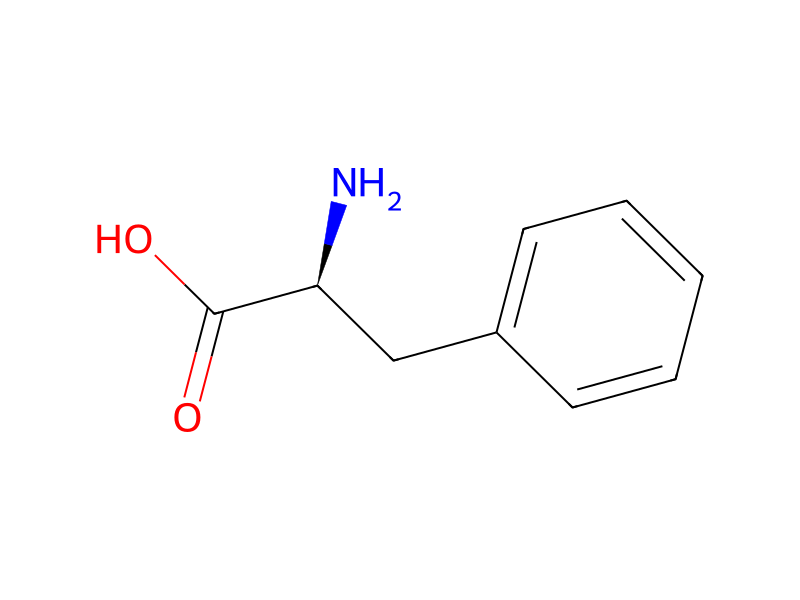
Cl.N[C@H](C(O)=O)CC1C=CC=CC=1.[CH:14]1[CH:19]=[C:18]([CH:20]=[O:21])[C:17]([CH:22]=[O:23])=[CH:16][CH:15]=1.SCCO.N(C(OC(C)(C)C)=O)[C@H](C(N[C@H](C(N[C@H](C(N[C@H](C(N[C@H](C(O)=O)CC1C=CC=CC=1)=O)CC(C)C)=O)CC1C=CC=CC=1)=O)CC(C)C)=O)CC1C=CC=CC=1>CO>[CH:14]1[CH:19]=[C:18]([CH:20]=[O:21])[C:17]([CH:22]=[O:23])=[CH:16][CH:15]=1Participants
6




Procedure
Four aliquots of the conjugate were hydrolyzed with concentrated HCl at 115° C. for 20 hours and analyzed for phenylalanine. The phenylalanine was quantified as the o-phthalaldehyde/2-mercaptoethanol derivative using reverse phase HPLC with a fluorescence detector (HPLC conditions as Example 24 except the eluent gradient was 12% to 80% methanol over 20 min. and then held at 80% for 5 min.). The o-phthalaldehyde derivative was prepared as given in Example 24. For a 25 μL aliquot of the conjugate, 26 nmoles phenylalanine were found. This corresponds to 0.26 μmoles BOCPheLeuPheLeuPhe on the conjugate.
Workup
- customover 20 min.
Sources & evidence
- ORD record
- ord-14382bf0085c49fea90fd46467495ff8
- Source dataset
- uspto-grants-1998_02
- Patent number
- US05714166
Linked notes
Loading…