Reaction equation

Br[CH2:2][CH2:3][CH2:4][CH2:5][CH2:6][CH2:7][CH2:8][CH2:9][CH2:10][CH2:11][CH2:12]CCC.C(OCC(F)(F)[F:31])(=O)CCCCCCCCC#C.C(OCC(F)(F)F)(=O)CCCCCCCCC=C.C(O)(=O)CCCCCCCCC#C.C(O)(=O)CCCCCCCCC=C.FC(F)(F)CO.C1(N=C=NC2CCCCC2)CCCCC1>CS(C)=O.CN(C)C1C=CN=CC=1>[F:31][CH2:2][CH2:3][CH2:4][CH2:5][CH2:6][CH2:7][CH2:8][CH2:9][CH2:10][CH:11]=[CH2:12]Participants
Reactant 7





Product 1
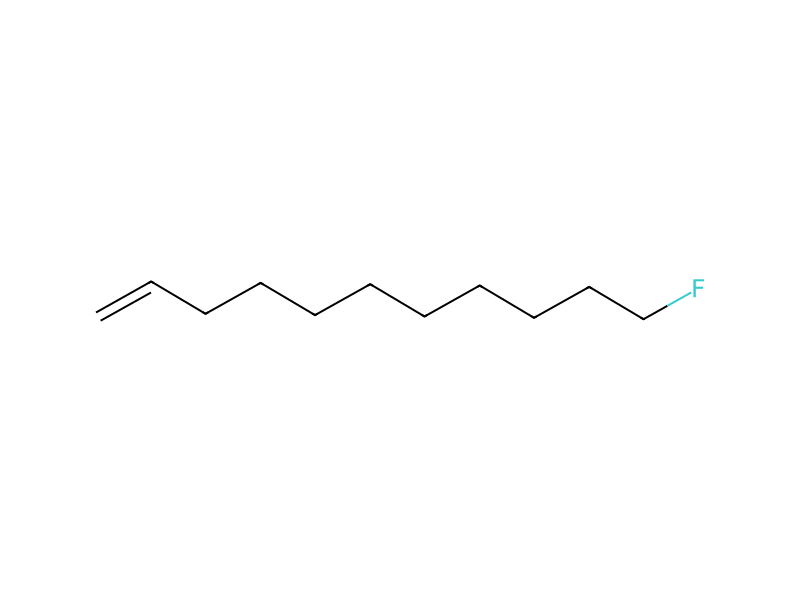
Reagents, catalysts & solvents 2


Procedure
Glassware used for surface modification was cleaned with organic solvents and etched overnight in basic detergent solution. Prior to use, it was rinsed with ultrapure water and dried at 120° C. 1-Hexadecene (98%, Sigma-Aldrich) was purified by column chromatography and vacuum distillation. 1-Hexadecyne was obtained by reacting 1-bromotetradecane with lithium acetylide ethylenediamine complex in dimethylsulfoxide. 11-Fluoroundec-1-ene was synthesized as described elsewhere.14 2,2,2-Trifluoroethyl undec-10-ynoate and 2,2,2-trifluoroethyl undec-10-enoate were synthesized by esterification of 10-undecynoic acid, respectively 10-undecenoic acid, with 2,2,2-trifluoroethanol using N,N′-dicyclohexylcarbodiimide as a coupling reagent and 4-dimethylaminopyridine as a catalyst. Solvents used were either of analytical grade or distilled prior to use.
Workup
- distillationdistilled
Sources & evidence
- ORD record
- ord-0b2f3dd8dcb24da89fa6a77c85fd4e20
- Source dataset
- uspto-grants-2015_03
- Patent number
- US08993479B2
Linked notes
Loading…