HomeMCPSkillsWorkbenchOpenChem
HomeWorkbenchNotificationsMe
llms.txt · skill.md · MCP GuidePrivacy Policy · Terms of Service · Supportv1.8.4
  1. Home
  2. /Reaction

Potassium Carbonate → (4-(1-(1-Ethoxyethyl)-1H-pyrazol-4-yl)-7H-pyrrolo[2,3-d]pyrimidin-7-yl)methyl pivalate

HRID 880572
Print

Reaction equation

[C:1]([O:7][CH2:8][N:9]1[C:13]2[N:14]=[CH:15][N:16]=[C:17](Cl)[C:12]=2[CH:11]=[CH:10]1)(=[O:6])[C:2]([CH3:5])([CH3:4])[CH3:3].[CH2:19]([O:21][CH:22]([N:24]1[CH:28]=[C:27](B2OC(C)(C)C(C)(C)O2)[CH:26]=[N:25]1)[CH3:23])[CH3:20].C(=O)([O-])[O-].[K+].[K+]>C(OCC)(=O)C.O.[Pd].C1(P(C2C=CC=CC=2)C2C=CC=CC=2)C=CC=CC=1.C1(P(C2C=CC=CC=2)C2C=CC=CC=2)C=CC=CC=1.C1(P(C2C=CC=CC=2)C2C=CC=CC=2)C=CC=CC=1.C1(P(C2C=CC=CC=2)C2C=CC=CC=2)C=CC=CC=1>[C:1]([O:7][CH2:8][N:9]1[C:13]2[N:14]=[CH:15][N:16]=[C:17]([C:27]3[CH:26]=[N:25][N:24]([CH:22]([O:21][CH2:19][CH3:20])[CH3:23])[CH:28]=3)[C:12]=2[CH:11]=[CH:10]1)(=[O:6])[C:2]([CH3:5])([CH3:4])[CH3:3]
ParticipantsConditionsProcedureWorkupSources & evidenceReaction notes

Participants

7

Reactant 3

HCID 11430Potassium CarbonateHCID 467367981-(1-Ethoxyethyl)-4-(4,4,5,5-tetramethyl-1,3,2-dioxaborolan-2-yl)-1H-pyrazoleHCID 57868847Propanoic acid, 2,2-dimethyl-, (4-chloro-7H-pyrrolo(2,3-d)pyrimidin-7-yl)methyl ester

Product 1

HCID 57868870(4-(1-(1-Ethoxyethyl)-1H-pyrazol-4-yl)-7H-pyrrolo[2,3-d]pyrimidin-7-yl)methyl pivalate

Reagents, catalysts & solvents 3

HCID 11979704
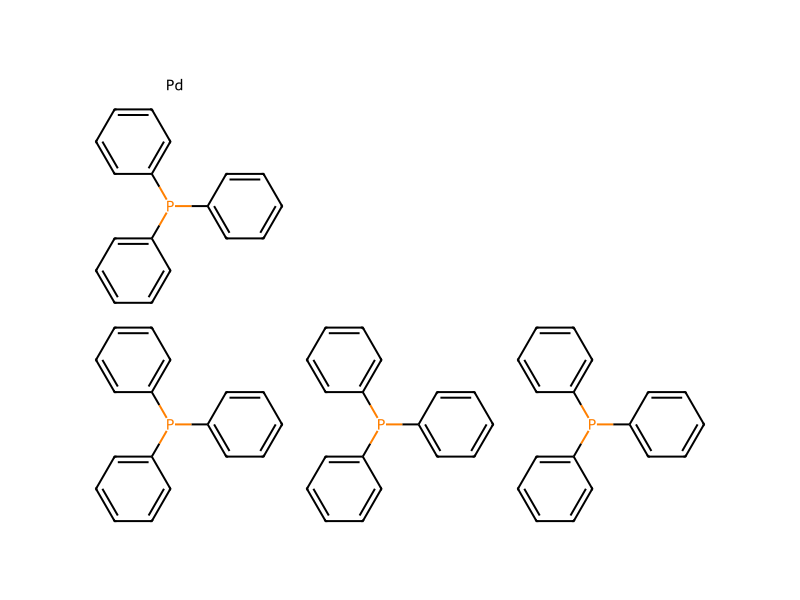
Tetrakis(triphenylphosphine)palladium
Catalyst
HCID 962WaterSolvent
HCID 8857Ethyl AcetateSolvent

Conditions

Temperature
82 °C

Procedure

To the quenched reaction mixture, which contains crude POM-protected chlorodeazapurine (3f) made as described above was added 4-(4,4,5,5-tetramethyl-1,3,2-dioxaborolan-2-yl)-1H-pyrazole (14, 200 g, 0.75 mol, 1.10 equiv) and potassium carbonate (K2CO3, 189 g, 1.37 mol, 2.0 equiv) at room temperature. The resulting mixture was degassed by passing a stream of nitrogen through the solution for 15 minutes before being treated with tetrakis(triphenylphosphine)-palladium(0) (7.9 g, 0.68 mmol, 0.01 equiv) and the resulting reaction mixture was heated at reflux (about 82° C.) for 10 hours. When the reaction was deemed complete by TLC (1:1 hexanes/ethyl acetate) and LCMS, the reaction mixture was cooled to room temperature, diluted with ethyl acetate (2 L) and water (1 L). The two layers were separated, and the aqueous layer was extracted with ethyl acetate (500 mL). The combined organic layers were washed with water (2×1 L) and brine (1 L) before being concentrated under reduced pressure to afford crude {4-[1-(1-ethoxyethyl)-1H-pyrazol-4-yl]-7H-pyrrolo[2,3-d]pyrimidin-7-yl]methyl pivalate (18) as a pale-yellow oil, which was directly used in the subsequent de-protection reaction without further purification.

Workup

  1. customTo the quenched reaction mixture, which
  2. customThe resulting mixture was degassed
  3. customfor 15 minutes
  4. customthe resulting reaction mixture
  5. temperaturewas heated
  6. temperaturethe reaction mixture was cooled to room temperature
  7. customThe two layers were separated
  8. extractionthe aqueous layer was extracted with ethyl acetate (500 mL)
  9. washThe combined organic layers were washed with water (2×1 L) and brine (1 L)
  10. concentrationbefore being concentrated under reduced pressure

Sources & evidence

ORD record
ord-0b25c7d344d34aab981036487680e3af
Source dataset
uspto-grants-2015_03
DOI
10.6084/m9.figshare.5104873.v1
Patent number
US08993582B2

Reaction notes

On this pageParticipantsConditionsProcedureWorkupSources & evidenceReaction notes