HomeMCPWorkbenchSkills
HomeWorkbenchNotificationsMe
llms.txt · MCP GuidePrivacy Policy · Terms of Service · Supportv1.8.3
  1. Home
  2. /Reaction

1-Hydroxybenzotriazole → N-(2-hydroxy-2-methylpropyl)-2-(1-isopropyl-1H-1,2,4-triazol-5-yl)-4,5-dihydrobenzo[b]pyrazolo[1,5-d][1,4]oxazepine-9-carboxamide

HRID 886125
Print

Reaction equation

HRID 886125 reaction equation
[CH:1]([N:4]1[C:8]([C:9]2[CH:10]=[C:11]3[N:17]([N:18]=2)[C:16]2[CH:19]=[C:20]([C:23](O)=[O:24])[CH:21]=[CH:22][C:15]=2[O:14][CH2:13][CH2:12]3)=[N:7][CH:6]=[N:5]1)([CH3:3])[CH3:2].CCN(C(C)C)C(C)C.CN(C(ON1N=NC2C=CC=NC1=2)=[N+](C)C)C.F[P-](F)(F)(F)(F)F.C1C=CC2N(O)N=NC=2C=1.[NH2:69][CH2:70][C:71]([CH3:74])([OH:73])[CH3:72]>CN(C=O)C>[OH:73][C:71]([CH3:74])([CH3:72])[CH2:70][NH:69][C:23]([C:20]1[CH:21]=[CH:22][C:15]2[O:14][CH2:13][CH2:12][C:11]3[N:17]([N:18]=[C:9]([C:8]4[N:4]([CH:1]([CH3:2])[CH3:3])[N:5]=[CH:6][N:7]=4)[CH:10]=3)[C:16]=2[CH:19]=1)=[O:24]
ParticipantsProcedureWorkupSources & evidenceReaction notes

Participants

7

Reactant 5

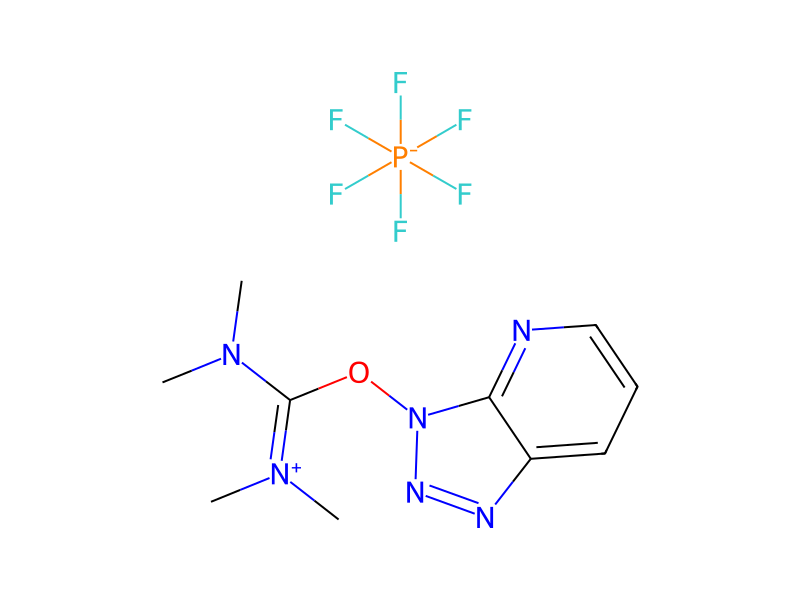
HCID 757711-HydroxybenzotriazoleHCID 81531DiisopropylethylamineHCID 951022-Propanol, 1-amino-2-methyl-HCID 9886157Methanaminium, N-((dimethylamino)(3H-1,2,3-triazolo(4,5-b)pyridin-3-yloxy)methylene)-N-methyl-, hexafluorophosphate(1-) (1:1)HCID 582047582-(2-Isopropyl-2H-[1,2,4]triazol-3-yl)-4,5-dihydro-6-oxa-1,10b-diaza-benzo[e]azulene-9-carboxylic acid


Product

1
HCID 68355376N-(2-hydroxy-2-methylpropyl)-2-(1-isopropyl-1H-1,2,4-triazol-5-yl)-4,5-dihydrobenzo[b]pyrazolo[1,5-d][1,4]oxazepine-9-carboxamideYield 67.3%

Reagents, catalysts & solvents 1

HCID 6228DimethylformamideSolvent

Procedure

2-(2-Isopropyl-2H-[1,2,4]triazol-3-yl)-4,5-dihydro-6-oxa-1,10b-diaza-benzo[e]azulene-9-carboxylic acid (0.2 g, 0.59 mmol) was suspended in DMF (5 mL) and DIPEA (0.21 mL, 1.2 mmol) added. The resultant solution was treated with HATU (0.23 g, 0.6 mmol) and HOBT (81 mg, 0.6 mmol) before the addition of 1-amino-2-methyl-propan-2-ol (52.5 mg, 0.59 mmol) then stirred for 18 h at RT. The reaction mixture was concentrated in vacuo and the resultant residue partitioned between DCM and water. The aqueous layer was extracted three times with DCM and the combined organic extracts washed with water, dried (Na2SO4), filtered and concentrated in vacuo. The resultant residue was subjected to flash chromatography (SiO2, gradient 0 to 10% MeOH in ethyl acetate) and recrystallisation from ethyl acetate to give 116 (163 mg, 67%). 1H NMR (CDCl3, 400 MHz): δ 8.46 (d, J=2.2 Hz, 1H); 7.94 (s, 1H); 7.72 (dd, J=8.4, 2.2 Hz, 1H); 7.22 (d, J=8.4 Hz, 1H); 6.86 (s, 1H); 6.66 (s, 1H); 5.74-5.61 (m, 1H); 4.57 (t, J=5.7 Hz, 2H); 3.50 (d, J=5.9 Hz, 2H); 3.22 (t, J=5.7 Hz, 2H); 2.18 (s, 1H); 1.59 (d, J=6.6 Hz, 6H); 1.31 (s, 6H). LCMS: RT=9.53 min, M+H+=411

Workup

  1. concentrationThe reaction mixture was concentrated in vacuo
  2. customthe resultant residue partitioned between DCM and water
  3. extractionThe aqueous layer was extracted three times with DCM
  4. washthe combined organic extracts washed with water
  5. dry with materialdried (Na2SO4)
  6. filtrationfiltered
  7. concentrationconcentrated in vacuo
  8. customThe resultant residue was subjected to flash chromatography (SiO2, gradient 0 to 10% MeOH in ethyl acetate) and recrystallisation from ethyl acetate

Sources & evidence

ORD record
ord-668540658a7346a3b86dbaef9db815da
Source dataset
uspto-grants-2012_08
DOI
10.6084/m9.figshare.5104873.v1
Patent number
US08242104B2

Reaction notes

On this pageParticipantsProcedureWorkupSources & evidenceReaction notes