HomeMCPWorkbenchSkills
HomeWorkbenchNotificationsMe
llms.txt · MCP GuidePrivacy Policy · Terms of Service · Supportv1.8.3
  1. Home
  2. /Reaction

Hydrochloric Acid → 1H-Indazole, 5-chloro-

HRID 896837
Print

Reaction equation

HRID 896837 reaction equation
N[C:2]1[CH:3]=[C:4]2[C:8](=[CH:9][CH:10]=1)[NH:7][N:6]=[CH:5]2.N([O-])=O.[Na+].[ClH:15]>O.[Cu]Cl>[Cl:15][C:2]1[CH:3]=[C:4]2[C:8](=[CH:9][CH:10]=1)[NH:7][N:6]=[CH:5]2
ParticipantsConditionsProcedureWorkupSources & evidenceReaction notes

Participants

6

Reactant 3

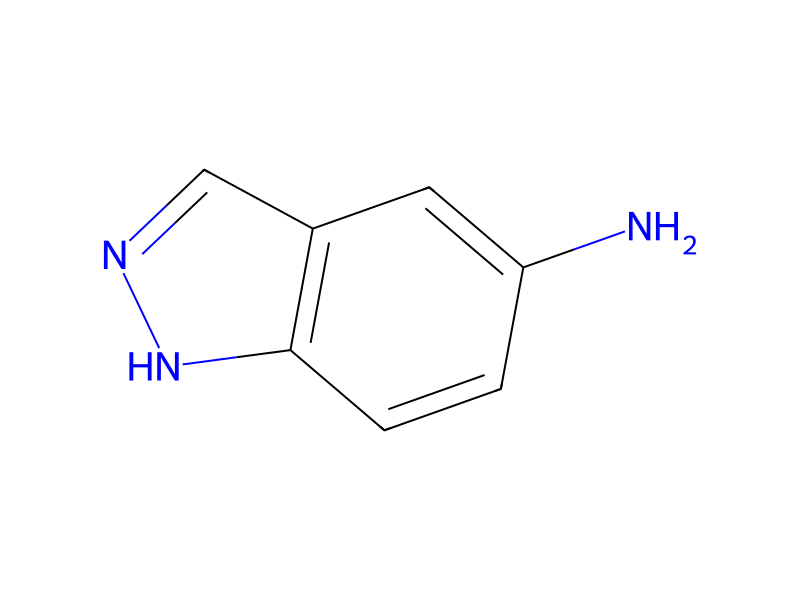
HCID 313Hydrochloric Acid2×HCID 880121H-Indazol-5-amineHCID 23668193Sodium Nitrite

Product 1

HCID 696811H-Indazole, 5-chloro-

Reagents, catalysts & solvents 2

HCID 62652Cuprous chlorideCatalystHCID 962WaterSolvent2×

Conditions

Temperature
-5 °C

Procedure

5-Amino-1H-indazole (15.41 g, 116 mmol) was suspended in a mixture of water (250 mL), ice (250 mL), and concentrated HCl (100 mL). The mixture was cooled in an ice-salt bath to an internal temperature of −5° C. To this mixture, was added a solution of sodium nitrite (8.78 g, 127 mmol) in water (75 mL), which had been cooled to 0° C. The resulting diazonium solution was stirred for 15 minutes at −5° C. A solution of copper (I) chloride (14.9 g, 151 mmol) in concentrated HCl (150 mL) was cooled to 0° C. and then added to the diazonium solution dropwise, causing an orange precipitate to form. The cooling bath was removed to allow the reaction to warm to room temperature. Gas evolution began at 10° C. internal temperature. After stirring at room temperature for 1.5 hours, the gas evolution subsided. The flask was then heated to 60° C. for 30 minutes, then cooled to ˜15° C. A brown precipitate formed. The precipitate was collected by suction filtration and dried in a vacuum dessicator over NaOH for 16 hours to give crude 5-chloro-1H-indazole (25.6 g) as a tan powder.


Workup

  1. temperaturehad been cooled to 0° C
  2. customto form
  3. customThe cooling bath was removed
  4. customthe reaction
  5. temperatureto warm to room temperature
  6. custombegan at 10° C.
  7. temperatureThe flask was then heated to 60° C. for 30 minutes
  8. temperaturecooled to ˜15° C
  9. customA brown precipitate formed
  10. filtrationThe precipitate was collected by suction filtration
  11. dry with materialdried in a vacuum dessicator over NaOH for 16 hours

Sources & evidence

ORD record
ord-5e36c0ab59d34027b0a1d809cbcd06aa
Source dataset
uspto-grants-2005_07
DOI
10.6084/m9.figshare.5104873.v1
Patent number
US06919461B2

Reaction notes

On this pageParticipantsConditionsProcedureWorkupSources & evidenceReaction notes